A Practical Guide for Freelancers, Consultants, and Business Owners Who Want to Keep More of What They Earn
If you’re self-employed, you already know taxes hit differently. There’s no employer withholding Social Security and Medicare for you. No HR department splitting payroll taxes. It’s all on your shoulders.
But here’s the real question: Are you paying exactly what you owe — or are you quietly overpaying thousands every year in self-employment taxes?
Many freelancers, consultants, S corporation owners, and single-member LLCs unintentionally overpay because they don’t fully understand how self-employment tax works — or how to legally reduce it.
This guide will help you identify whether you’re overpaying and what you can do about it.
At a Glance
- Self-employment tax is 15.3% (12.4% Social Security + 2.9% Medicare)
- It applies to net profit, not revenue
- You may be overpaying if:
- You’re not deducting all legitimate business expenses
- You haven’t evaluated S corporation election
- You’re missing retirement contribution deductions
- You’re not taking the Qualified Business Income (QBI) deduction
- You’re miscalculating estimated payments
- Strategic entity structuring and tax planning can legally reduce self-employment tax
- Proper planning often saves business owners thousands per year
What Is Self-Employment Tax?
Self-employment tax covers:
- Social Security (12.4%)
- Medicare (2.9%)
Together: 15.3% on net earnings.
According to the Internal Revenue Service (IRS), if you earn $400 or more in net self-employment income, you must file and pay self-employment tax (see Schedule SE: IRS Schedule SE (Form 1040)).
Unlike W-2 employees who split this with their employer, self-employed individuals pay the full 15.3% themselves.
However — and this is important — you are allowed to deduct the “employer-equivalent” portion (half) when calculating adjusted gross income (IRS Tax Topic 554).
Still, without strategic planning, that 15.3% adds up quickly.

Step 1: Are You Calculating It Correctly?
Self-employment tax is based on:
Net profit = Revenue – Business Expenses
If you’re calculating it based on gross revenue, you’re already overpaying.
Common missed deductions include:
- Home office deduction
- Business use of vehicle
- Software subscriptions
- Marketing and advertising
- Professional services
- Business travel
- Equipment depreciation
- Health insurance premiums
The IRS outlines deductible expenses in Publication 334 (Tax Guide for Small Business): IRS Publication 334.
If your bookkeeping isn’t clean or up to date, you may not even know what your true net profit is.
Step 2: Are You Missing the Qualified Business Income (QBI) Deduction?
The Qualified Business Income deduction (Section 199A) allows eligible businesses to deduct up to 20% of qualified business income.
Learn more directly from the IRS here:
IRS qualified business income deduction guidance
This deduction does not directly reduce self-employment tax, but it reduces taxable income — which significantly lowers overall tax liability.
Many business owners assume they don’t qualify or don’t calculate it properly.
Step 3: Should You Be an S Corporation?
This is where many high-earning business owners overpay.
If you operate as:
- Sole proprietor
- Single-member LLC
- Partnership
You pay self-employment tax on all net profit.
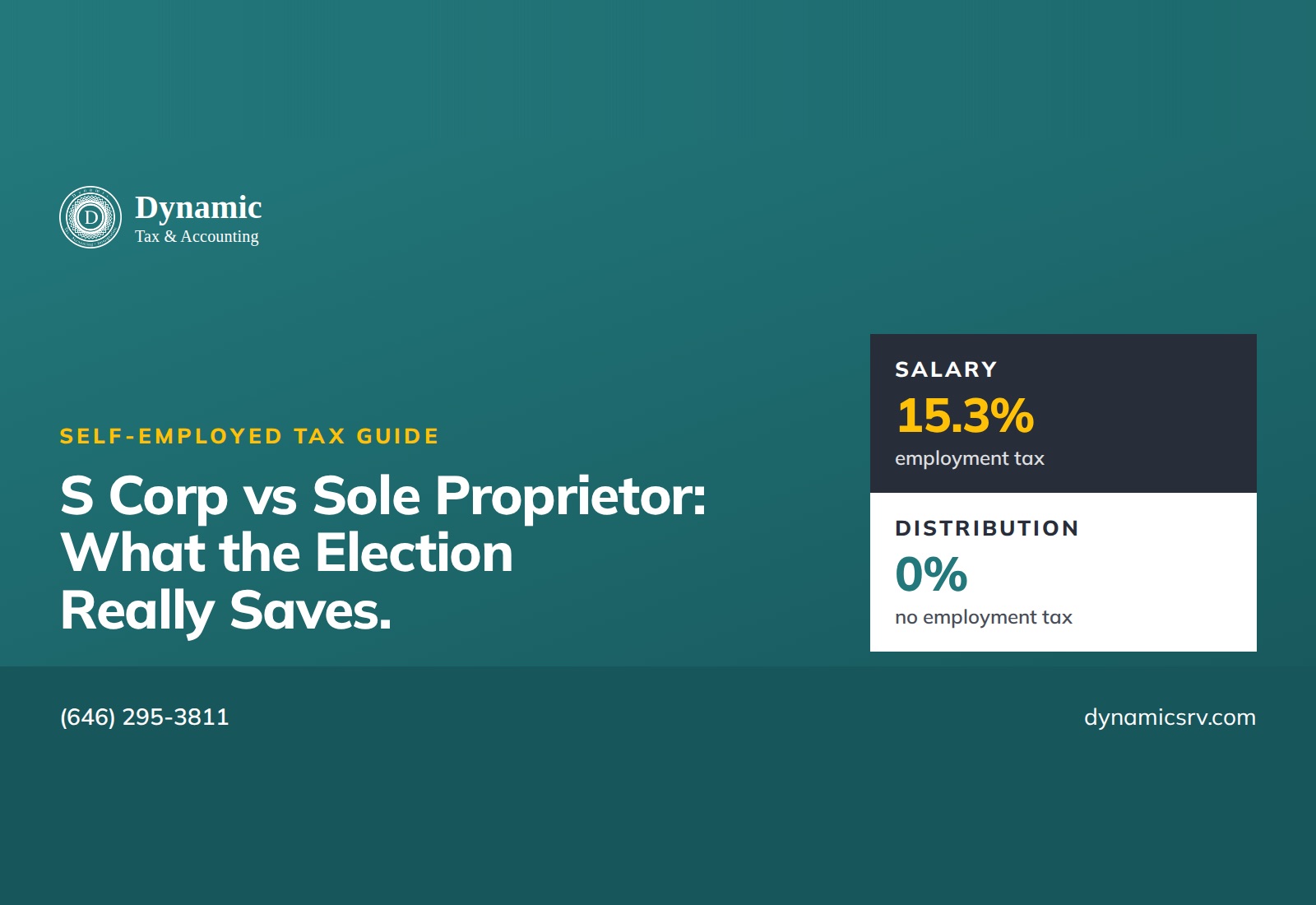
But if you elect to be taxed as an S corporation (IRS S corporation guidance), you can:
- Pay yourself a “reasonable salary” (subject to payroll taxes)
- Take remaining profit as distributions (not subject to self-employment tax)
Example:
If your net profit is $150,000:
Sole proprietor:
- 15.3% × $150,000 = $22,950 in SE tax
S corp (salary $80,000):
- Payroll tax on $80,000
- Remaining $70,000 distribution not subject to SE tax
That difference can mean thousands in savings annually.
However, S corps come with:
- Payroll requirements
- Compliance costs
- Reasonable compensation rules
- Additional filings
This is why strategic analysis is critical before making the election.

Step 4: Are You Contributing to the Right Retirement Plan?
Contributions to:
- SEP IRA
- Solo 401(k)
- SIMPLE IRA
Can significantly reduce taxable income.
For example, a Solo 401(k) allows:
- Employee deferral
- Employer profit-sharing contribution
Contribution limits are outlined here:
IRS Solo 401(k) guidance
Proper retirement strategy reduces both:
- Current taxable income
- Long-term tax exposure
Without a retirement strategy, you may be overpaying annually.
Step 5: Are You Making Accurate Quarterly Estimated Payments?
Self-employed individuals must pay estimated taxes quarterly:
- April
- June
- September
- January
(IRS estimated tax guidance: IRS estimated tax guidance)
Overestimating payments isn’t technically “overpaying,” but it can create unnecessary cash flow strain.
Underestimating results in penalties.
Strategic forecasting ensures you:
- Pay what you owe
- Avoid penalties
- Preserve working capital
Step 6: Are You Structuring Income Properly?
Advanced strategies may include:
- Income timing
- Expense acceleration
- Accountable plans
- Family payroll strategies
- Depreciation planning (Section 179 & bonus depreciation)
The IRS provides details on Section 179 here:
IRS Publication 946
When executed correctly, these strategies reduce taxable income — and in some cases reduce exposure to self-employment tax.
Signs You’re Probably Overpaying
You might be overpaying if:
- You’ve never had a proactive tax strategy session
- You only talk to your accountant at filing time
- Your net profit is above $75,000 and you’re still a sole proprietor
- You don’t know what your effective tax rate is
- You don’t know your quarterly projections
Reactive filing ≠ strategic tax planning.
The Difference Between Filing and Planning
Many tax preparers focus on:
- Historical compliance
- Filing what already happened
Strategic tax planning focuses on:
- Structuring income
- Projecting liability
- Adjusting entity structure
- Reducing self-employment exposure
This is where major savings happen.
How Dynamic Tax and Accounting Helps
Dynamic Tax and Accounting provides proactive tax planning, bookkeeping, compliance, and advisory services for entrepreneurs and growing businesses.
We serve clients across NYC (Queens, Bronx) and Totowa, NJ, as well as virtually nationwide.
Our focus isn’t just filing — it’s building strategies that:
- Reduce self-employment taxes legally
- Improve cash flow
- Optimize entity structure
- Align tax strategy with long-term wealth building
If you’re wondering whether you’re overpaying, that’s exactly the conversation we specialize in.
How to Know for Sure
The only real way to determine whether you’re overpaying is to:
- Review last year’s return
- Analyze net profit trends
- Compare entity structures
- Run projections under multiple scenarios
Often we run:
- Sole prop scenario
- S corp scenario
- Retirement maximization scenario
Side-by-side.
The difference is frequently eye-opening.
Final Thoughts: Keep More of What You Earn
Self-employment taxes are unavoidable.
Overpaying them is optional.
With proper planning, structure, and forecasting, many business owners can:
- Reduce tax liability
- Increase take-home income
- Improve long-term financial positioning
If you’re working hard for your money, your tax strategy should work just as hard for you.
Ready to Find Out If You’re Overpaying?
Let’s run the numbers.
📞 Call us at (646) 295-3811
📧 Email: admin@dynamicsrv.com
🌐 Contact us here: https://www.dynamicsrv.com/contact-us-2/
Schedule a strategic review and find out if you’re paying more than you legally need to.
Resources
Publication 946 (Depreciation): IRS Publication 946
IRS Schedule SE (Self-Employment Tax): IRS Schedule SE (Form 1040)
IRS Publication 334 (Tax Guide for Small Business): IRS Publication 334
Qualified Business Income Deduction Overview: IRS qualified business income deduction guidance
S Corporation Information: IRS S corporation guidance
One-Participant 401(k) Plans: IRS Solo 401(k) guidance
Estimated Taxes: IRS estimated tax guidance
Want to get in touch?
Email: admin@dynamicsrv.com
Call: (646) 295-3811
Schedule a consultation today and turn tax season into a strategic advantage.
Bronx Office
- 2044 McGraw Ave., Bronx, NY 10462
Queens Office
- 168-29 Hillside Ave. 2C, Jamaica, NY 11432
Buffalo Office
- 1989 Clinton St, Buffalo, NY 14206
New Jersey Office
- 63 Union Blvd. Totowa, NJ 07512
Call us at (646) 295-3811
Email: admin@dynamicsrv.com
Contact us
Disclaimer: This article is for informational purposes only and does not constitute legal, tax, or financial advice. Individual circumstances vary. Please consult a qualified tax professional before making financial decisions.