By Abdul Chowdhury | Dynamic Tax & Accounting
At a Glance
- April 15, 2026 is both the individual tax filing deadline and the Q1 estimated tax payment due date — two obligations in one day
- USPS no longer guarantees same-day postmarks — mailing a paper return on April 15 can result in a late-filing penalty
- The failure-to-file penalty is 5% per month on unpaid tax — 10× worse than the failure-to-pay penalty
- Filing Form 4868 gives you until October 15 to file — but does not extend your time to pay
- On a $5,000 balance, the failure-to-file penalty is $250 per month — up to 25% of what you owe
- Self-employed filers and small business owners owe Q1 2026 estimated taxes on the same day
- E-filing is the safest and fastest option — you get a confirmation timestamp immediately
- Dynamic Tax & Accounting serves clients in Queens, the Bronx, Totowa NJ, Buffalo, and virtually nationwide
The April 15 tax filing deadline is closing in fast. If you haven’t completed your tax preparation yet, you’re not alone — millions of Americans wait until the final stretch. But this year, there’s an extra wrinkle you need to know about before you seal that envelope or click “submit.”
Whether you’re searching for a tax preparer near me or planning to e-file your tax return for 2026 on your own, what follows is a complete last-minute filing guide: every document to gather, every deduction to check, the truth about IRS tax extensions in 2026, and the estimated tax obligation most people completely forget about. Read this before you file.
Two Deadlines in One Day: April 15 Tax Deadline Explained
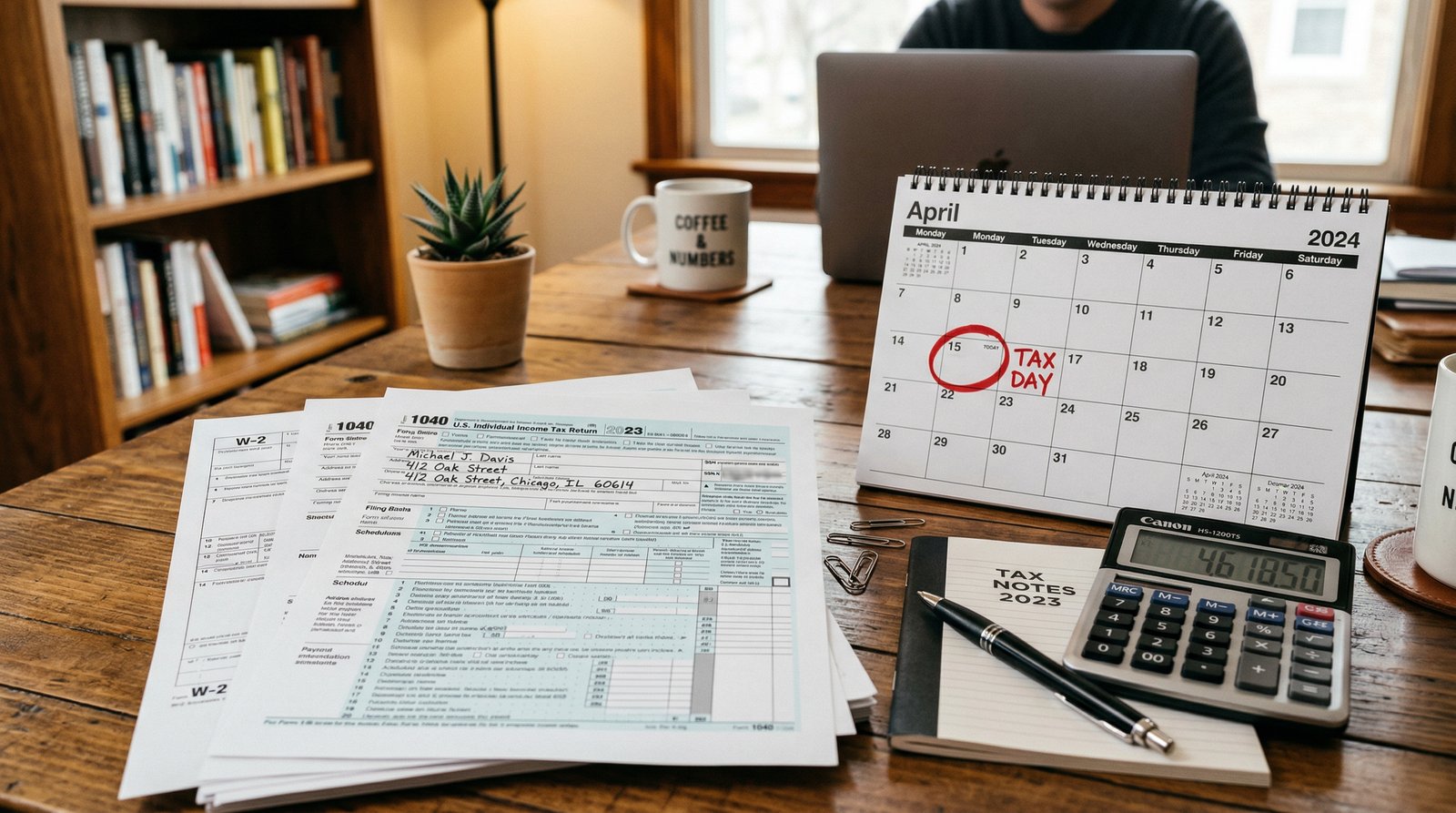
Most people know April 15 as the tax filing deadline. What’s easy to forget is that it’s also the due date for your Q1 2026 estimated tax payment.
According to the IRS, if you’re self-employed, a freelancer, or had significant non-wage income in early 2026 — investment gains, rental income, side business revenue — you owe that first quarterly installment on the same day your annual return is due.
Missing either obligation can mean penalties and interest. April 15 is a two-for-one deadline, so plan accordingly.
The USPS Warning That’s Catching Filers Off Guard
Here’s the change that’s tripping up paper filers this year: USPS no longer guarantees a same-day postmark on mail dropped off or postmarked on April 15.
Under older practices, a stamped April 15 envelope was treated as filed on time. That’s no longer a safe assumption. As Wipfli has reported, USPS operational changes mean that mail processed late in the day may carry a postmark of April 16 or later — which the IRS treats as a late filing. Even one day late can trigger the failure-to-file penalty.
Your three options if you’re filing by mail:
- E-file your tax return — the safest and fastest choice. You’ll get an immediate confirmation, and the submission timestamp is your official filing date. The IRS processes e-filed returns within 24–48 hours and issues refunds in as little as 21 days via direct deposit.
- Use certified mail — if you must mail a paper return, use USPS Certified Mail. The date on the certified mail receipt is your proof of timely filing under IRS rules.
- Request a hand-cancelled postmark — go to your post office counter before closing on April 15 and ask the clerk to hand-cancel your envelope. This stamps the exact date directly and eliminates the risk of delayed processing.
E-filing is the clear best option. If you’re still on paper, do not drop your return in a collection box on April 15 and assume you’re covered.
Signs You Should File an IRS Tax Extension in 2026 Instead of Rushing
Not everyone should scramble to file by April 15. Sometimes the right move is to slow down, file Form 4868, and buy yourself until October 15 to get it right.
Check this list — if any apply to you, an IRS tax extension in 2026 may be the smarter call:
- You’re waiting on a Schedule K-1 from a partnership, S-corporation, or trust (these often arrive late)
- You had a major transaction in 2025 — a business sale, property sale, inheritance, or stock options — and you’re not sure how to report it
- You received a corrected 1099 after you already started your return
- You’re missing records for business expenses and can’t reconstruct them quickly
- You had a significant life change — divorce, death of a spouse, new child — that complicates your filing status
- You started a new business or rental property and aren’t sure what to deduct
- Your tax preparer told you they need more time
- You simply haven’t had the time to do it right
The critical rule everyone gets wrong: An extension gives you more time to file — it does not give you more time to pay. If you owe money, it is due April 15 regardless of whether you file an extension. Estimate what you owe and pay it by April 15 to avoid interest and late-payment penalties.
When you should file now instead of extending:
- Your return is straightforward and your documents are in order
- You’re expecting a refund (there’s no penalty for filing late when you’re owed money — but why delay your refund?)
- You want to stop thinking about this
Understanding the Penalties — With Real Numbers
The IRS runs two separate penalty clocks the moment you miss the April 15 deadline, and confusing them is an expensive mistake.
Failure-to-File Penalty
5% of unpaid tax per month (or partial month), up to a maximum of 25%
If you owe $5,000 and don’t file by April 15:
- Month 1: $250
- Month 2: $500 cumulative
- Month 5: $1,250 — the maximum (25% of $5,000)
After five months without filing, you’ve added $1,250 to your tax bill — before interest.
Failure-to-Pay Penalty
0.5% of unpaid tax per month, up to 25%
On the same $5,000 balance:
- Month 1: $25
- Month 12: $300 cumulative
The failure-to-pay penalty is ten times smaller than the failure-to-file penalty. This is why tax professionals always say: file on time even if you can’t pay in full. The filing is the part that costs you most if you miss it.
Interest accrues separately on top of both penalties at the federal short-term rate plus 3%. Currently, that’s approximately 7–8% annually.
If you can’t pay your full balance, the IRS has options: Direct Pay for online payments, payment plans (installment agreements), and in cases of genuine hardship, Offers in Compromise. The IRS would rather collect something than nothing — but they’ll penalize you while you wait.
Your Complete Last-Minute Document Checklist
Before you sit down to file, gather everything you need. Missing a single form can slow down your return or — worse — cause errors that trigger an audit or a letter from the IRS.
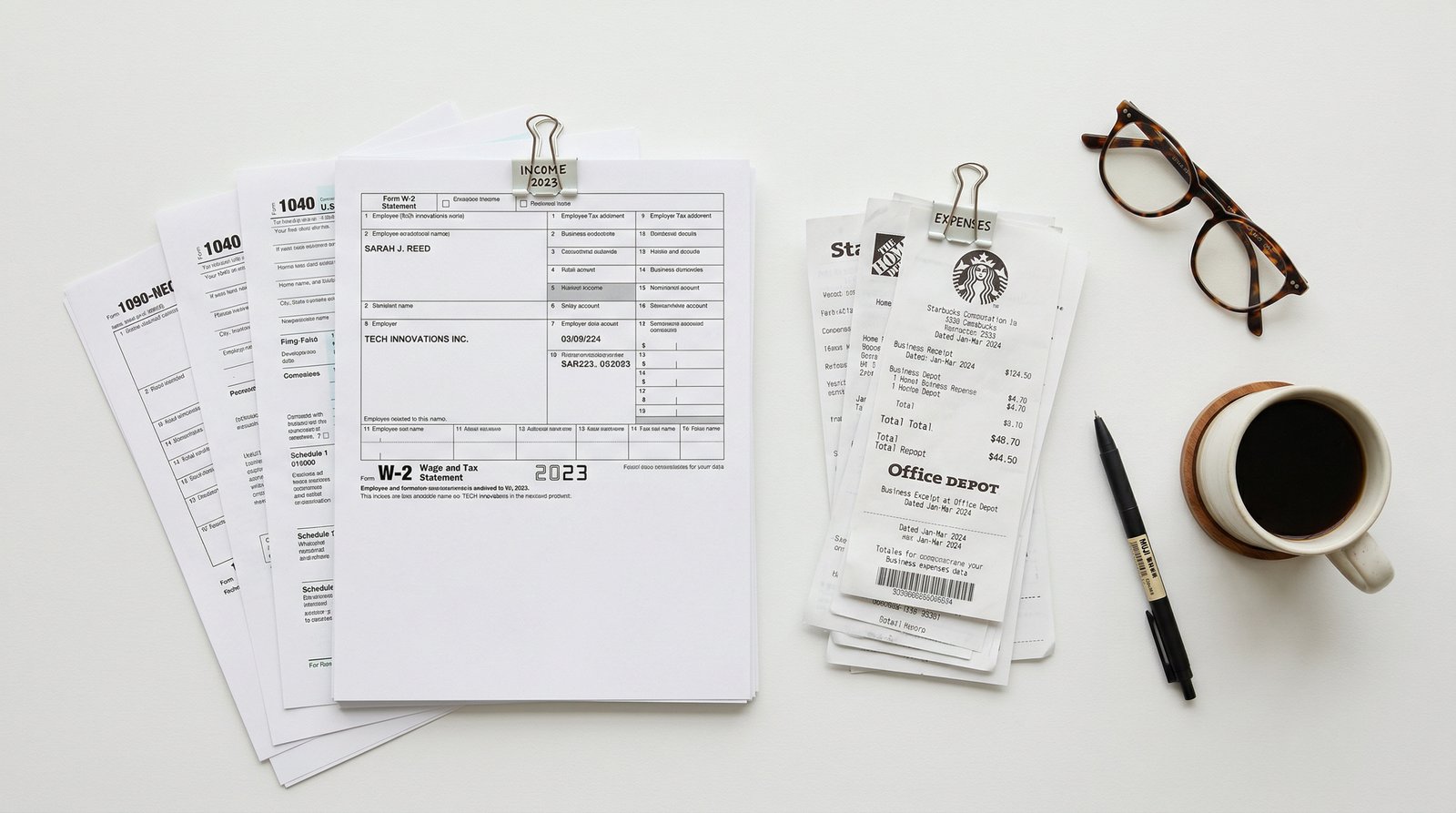
Income documents:
- W-2s from all employers
- 1099-NEC or 1099-K forms (freelance, gig work, payment apps like Venmo and PayPal)
- 1099-INT and 1099-DIV (bank interest, dividends)
- 1099-B (investment sales — stock, crypto, mutual funds)
- Schedule K-1 (partnerships, S-corps, trusts, REITs)
- SSA-1099 (Social Security benefits)
- 1099-R (retirement distributions, pension income)
- 1099-G (state tax refunds, unemployment income)
Deduction and credit records:
- Form 1098 — mortgage interest statement from your lender
- Property tax receipts (for itemizing)
- Charitable donation receipts — cash donations and non-cash donations (if over $250, you need a written acknowledgment)
- Medical expense records (only deductible above 7.5% of AGI — IRS Publication 502)
- Student loan interest statement (Form 1098-E)
- Childcare expenses (provider’s name, address, and Tax ID or SSN — needed for the Child and Dependent Care Credit)
- Education expenses (Form 1098-T from your school)
Self-employed or small business owners:
- Business income and expense records (bank statements, QuickBooks export, invoices)
- Home office square footage and total home expenses (rent/mortgage, utilities, insurance)
- Vehicle mileage logs (2025 IRS standard mileage rate: 70 cents per mile for business)
- Health insurance premiums paid for yourself and your family
- Retirement contributions (SEP-IRA, Solo 401(k), SIMPLE IRA)
- Business-use asset purchases (for depreciation or Section 179 deductions)
Other items to check:
- Last year’s tax return (your prior-year AGI is needed to e-file your tax return)
- Bank account and routing numbers (for direct deposit of any refund)
- IP PIN, if you requested one from the IRS (IRS IP PIN tool)
Deductions People Commonly Miss at the Last Minute
Even experienced filers leave money on the table when they’re rushing. Before you hit submit, run through this list:
Home office deduction: If you’re self-employed and use part of your home exclusively and regularly for business, you can deduct that portion of your rent or mortgage, utilities, and insurance. The IRS simplified method is $5 per square foot, up to 300 square feet — a maximum $1,500 deduction with no recordkeeping headache. Or use the actual expense method to capture more. See IRS Publication 587 for the full rules.
Vehicle expenses: Business-related driving is deductible. You can use the standard mileage rate (70 cents/mile for 2025) or deduct actual costs — gas, insurance, repairs, registration, and depreciation. Either way, you need a mileage log. A 10,000-mile business year at the standard rate = $7,000 deduction.
Health insurance premiums: Self-employed individuals can deduct 100% of health, dental, and vision premiums paid for themselves, their spouse, and their dependents — even if they don’t itemize deductions. This deduction reduces your AGI directly. See IRS Publication 535.
Retirement contributions — SEP-IRA: Here’s a frequently missed last-minute opportunity. Contributions to a SEP-IRA for the 2025 tax year can be made up until your filing deadline, including extensions. For 2025, you can contribute up to 25% of net self-employment income, with a maximum of $70,000. If you haven’t maxed this out, you can make a contribution today and deduct it on your 2025 return.
Example: A self-employed consultant with $120,000 in net income contributes $30,000 to a SEP-IRA. That $30,000 comes directly off taxable income — at a 24% marginal rate, that’s a $7,200 tax reduction funded by money that stays in your retirement account.
Student loan interest: You can deduct up to $2,500 in student loan interest paid in 2025, subject to income phase-outs. This is an above-the-line deduction — you don’t need to itemize to claim it.
2026 SALT Cap Update: Under the One Big Beautiful Bill Act passed in July 2025, the State and Local Tax (SALT) deduction cap was raised from $10,000 to $40,400 for 2026, with a phase-out for high earners above $505,000 MAGI. This is for the 2026 tax year — not your 2025 return you’re filing now. But it’s worth knowing as you plan ahead.
The Q1 Estimated Tax Payment for 2026 — With a Real Example
If you’re self-employed, own a small business, or receive significant non-wage income, you likely need to make an estimated tax payment for Q1 2026 by April 15. This covers income earned January through March 2026.
Use IRS Form 1040-ES to calculate your payment. The instructions include worksheets for estimating your annual income and computing your required quarterly amount.
The safe harbor rule: To avoid underpayment penalties entirely, your quarterly payments must add up to at least:
- 100% of the tax shown on your 2025 return, OR
- 90% of your 2026 tax liability — whichever is smaller
- If your 2025 AGI exceeded $150,000: 110% of last year’s tax (higher-income taxpayers must pay more)
Example calculation:
Say you’re a freelance designer with $80,000 in projected 2026 net self-employment income.
Self-employment tax: 15.3% × $80,000 × 0.9235 (the SE tax adjustment) = $11,271
Federal income tax (after the SE tax deduction and standard deduction): estimated ~$7,800
Total estimated annual tax: ~$19,071
Q1 payment (25% of total): ~$4,768
Pay online at IRS Direct Pay — it’s free, takes five minutes, and gives you an immediate confirmation. You can also pay via EFTPS for business accounts or use a debit/credit card through an IRS-authorized processor (note: card payments carry a processing fee).
Skipping this payment means an underpayment penalty when you file next year. It’s not catastrophic, but it’s unnecessary.
If You Can’t Pay in Full — Here’s What to Do
A common mistake: people who owe more than they can pay simply don’t file. That’s the worst outcome. Here’s the right approach:
Step 1: File on time (or extend). The failure-to-file penalty is ten times larger than the failure-to-pay penalty. Filing without full payment is always better than not filing.
Step 2: Pay as much as you can. Even a partial payment reduces the balance on which penalties and interest accrue. Pay at IRS Direct Pay today.
Step 3: Set up a payment plan. If you can’t pay your full balance by April 15, the IRS offers online payment agreements. For balances under $50,000, you can set up a payment plan online without calling the IRS. Interest and penalties continue to accrue, but you stop the clock on the more serious consequences.
Step 4: Consider an Offer in Compromise. If you’re in genuine financial hardship and can’t realistically pay your full tax debt, the IRS Offer in Compromise program allows you to settle for less than the full amount owed. This is complex and requires professional help — but it’s a legitimate option for the right circumstances.
How Dynamic Tax & Accounting Helps with Last-Minute Tax Preparation in NYC
At Dynamic Tax & Accounting, we specialize intax preparation services for New York residents — including clients in Queens, the Bronx, and throughout NYC — as well as Totowa NJ, Buffalo, and virtually anywhere in the country.
If you’re searching for a reliable accountant in the Bronx, NY, an experienced tax preparer in Queens, or trusted tax preparation services in New York, our team is ready to help in the final stretch. Here’s exactly what we can do:
- Return review before you file: Before you click submit, have a professional review your return for missed deductions, errors, and red flags. One missed deduction can cost more than the review itself.
- Extension filing: We’ll calculate what you owe, file your extension, and help you make the right payment by April 15 so you don’t rack up penalties.
- Estimated tax planning: We calculate your Q1 2026 estimated tax payment and set up a quarterly plan so you’re never behind again.
- SEP-IRA last-minute contributions: We identify whether a last-minute SEP-IRA contribution makes sense for your situation and handle the math.
- Payment plan setup: If you owe money and can’t pay in full, we’ll help you navigate IRS payment options and set up an installment agreement.
- Year-round support: We don’t disappear after April 15. Our team monitors tax law changes and keeps your strategy current throughout the year.
We serve clients in person at our Queens, Bronx, Totowa NJ, and Buffalo offices — and virtually for clients across the country. Whether you need a small business tax accountant in NYC or just need someone to review your personal return before the April 15 tax deadline, Dynamic Tax & Accounting is here.
Frequently Asked Questions
What are some last-minute tax filing tips to avoid penalties?
File your return — or request an IRS tax extension using Form 4868 — by April 15, 2026, no matter what. The failure-to-file penalty (5% per month) is ten times more damaging than the failure-to-pay penalty. If you owe and can’t pay in full, file anyway and pay as much as you can. E-file your tax return for 2026 whenever possible — you get an immediate timestamp confirmation and avoid USPS postmark risks.
How do I find a qualified tax preparer near me in New York City?
Look for a licensed CPA, Enrolled Agent (EA), or accredited tax professional with local knowledge of New York State and New York City tax requirements. Dynamic Tax & Accounting offers in-person tax preparation services in Queens and the Bronx (NY) as well as Totowa, NJ — with virtual tax preparation services available for clients throughout New York and nationwide.
Does filing an IRS tax extension in 2026 give me more time to pay?
No. A Form 4868 extension gives you until October 15, 2026 to file your return — but your tax payment is still due April 15, 2026. If you expect to owe, estimate your balance and pay by April 15 to avoid interest and the failure-to-pay penalty.
Who needs to make an estimated tax payment for Q1 2026 by April 15?
Generally, anyone who expects to owe $1,000 or more in federal taxes and does not have sufficient withholding must make quarterly estimated tax payments. This includes self-employed individuals, freelancers, gig workers, small business owners, and anyone with significant investment, rental, or other non-wage income. Use IRS Form 1040-ES to calculate your Q1 2026 payment amount.
Contact Us
Don’t navigate the April 15 deadline alone. Reach out today:
Phone: (646) 295-3811
Email: admin@dynamicsrv.com
Online: www.dynamicsrv.com/contact-us-2/
Resources
- IRS — Estimated Taxes Guide: IRS estimated tax guidance
- IRS Form 4868 — Extension: IRS Form 4868
- IRS Form 1040-ES — Estimated Tax: IRS Form 1040-ES
- IRS Direct Pay: IRS Direct Pay
- IRS — Timely Mailing Rules: IRS private delivery service guidance
- IRS — Payment Agreement: IRS online payment agreement application
- IRS — Offer in Compromise: IRS Offer in Compromise program
- IRS Publication 502: IRS Publication 502
- IRS Publication 535: IRS Publication 535
- IRS Publication 587: IRS Publication 587
- IRS — IP PIN: IRS IP PIN tool
- IRS — Penalties: IRS Underpayment Of Estimated Tax By Individuals Penalty
- EFTPS: Electronic Federal Tax Payment System
Our Offices
Bronx Office: 2044 McGraw Ave., Bronx, NY 10462
Queens Office: 168-29 Hillside Ave. 2C, Jamaica, NY 11432
Buffalo Office: 1989 Clinton St, Buffalo, NY 14206
New Jersey Office: 63 Union Blvd. Totowa, NJ 07512
Disclaimer: This article is for informational purposes only and does not constitute legal, tax, or financial advice. Individual circumstances vary. Please consult a qualified tax professional before making financial decisions.