If you drive for DoorDash, Uber Eats, Instacart, or any other delivery platform in New York or New Jersey, one thing is certain: you are running your own small business in the eyes of the IRS. That comes with real tax responsibilities — and real opportunities to save money. This guide breaks down everything NYC-area delivery drivers need to know for 2025 and 2026, including a brand-new deduction on tip income that could put hundreds of dollars back in your pocket.
You Are an Independent Contractor, Not an Employee
Delivery apps do not withhold taxes from your earnings. Instead of receiving a W-2 at year-end, you get a Form 1099-NEC (Nonemployee Compensation) for any platform that paid you $600 or more. This single difference changes your entire tax situation.
Because you are classified as an independent contractor, you are responsible for:
- Reporting all your delivery income on Schedule C of your federal Form 1040
- Paying self-employment (SE) tax on your net profits
- Making quarterly estimated tax payments to avoid penalties
- Keeping records of every deductible business expense throughout the year
The IRS Gig Economy Tax Center makes clear that gig income is taxable regardless of whether you receive a 1099 or not — even cash tips count.
The Real Tax Burden: Income Tax Plus Self-Employment Tax
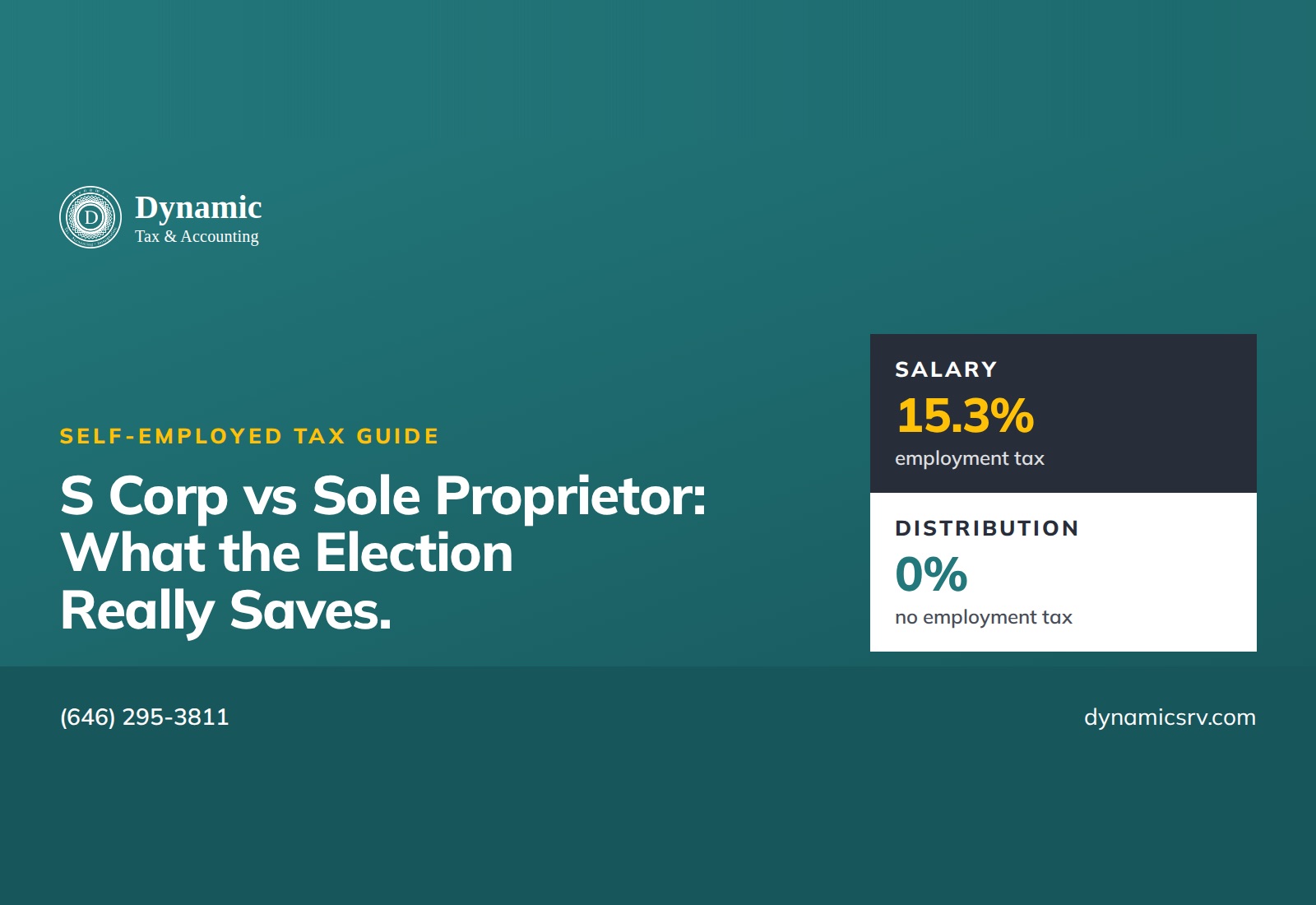
This is where many new gig workers get a nasty surprise. As a traditional employee, your employer splits Social Security and Medicare taxes with you. As a self-employed person, you pay both halves.
What Is the Self-Employment Tax Rate?
According to the IRS, the self-employment tax rate is 15.3% on net earnings:
| Tax Component | Rate |
|---|---|
| Social Security | 12.4% (on earnings up to $176,100 in 2025) |
| Medicare | 2.9% (no earnings cap) |
| Total SE Tax | 15.3% |
On top of SE tax, you also owe federal income tax at your regular bracket rate, plus New York State income tax (4%–10.9% depending on income) and, if you live in New York City, the NYC income tax (3.078%–3.876%). Add it all up, and many NYC delivery drivers owe 30–40 cents of every profit dollar in combined taxes.
The good news: deductions directly reduce your taxable net profit — and the lower your net profit, the lower both your income tax and your SE tax.
Top Tax Deductions for NYC Delivery Drivers
Tracking these deductions throughout the year is the single most effective way to lower your tax bill.
1. Mileage — Your Biggest Deduction
The IRS lets you deduct every mile driven for business at a standard rate:
- 2025 rate: 70 cents per mile (IRS standard mileage rates)
- 2026 rate: 72.5 cents per mile (IRS IR-2025-128)
If you drove 20,000 miles making deliveries in 2025, that is a $14,000 deduction — before anything else. Use a mileage tracking app (MileIQ, Stride, or similar) and log every trip. You can also deduct mileage driven to pick up supplies, to visit a tax professional, and for other direct business purposes.
Note: If you choose the standard mileage rate, you generally cannot also deduct the actual cost of gas, oil, or depreciation for the same vehicle. Pick the method that gives you the larger deduction — an enrolled agent can help you compare.
2. Your Phone
Your smartphone is your dispatch unit. You can deduct the business-use percentage of your monthly phone bill and, if you bought a new phone for the job, a portion of the purchase price. If you use your phone 80% for deliveries, 80% of the cost is deductible.
3. Insulated Bags, Equipment & Supplies
Insulated delivery bags, drink carriers, hot bags, and any other supplies you buy specifically for deliveries are fully deductible as business supplies.
4. Parking & Tolls
Every toll you pay while making deliveries — E-ZPass charges on the Triborough, the George Washington Bridge, tunnels into Manhattan — is deductible. So is metered parking you pay while waiting for an order. Save your receipts or export toll records from your E-ZPass account.
5. Data Plans, Apps & Software
Subscription fees for mileage trackers, accounting apps, or any software you use to manage your delivery business are deductible as a business expense.
The 2025–2026 "No Tax on Tips" Deduction — Big News for Delivery Workers
The One Big Beautiful Bill Act, signed into law on July 4, 2025, created a brand-new federal income tax deduction for tipped workers. Here is what NYC delivery drivers need to know.
How It Works
Eligible workers can deduct up to $25,000 per year in qualified tips from their federal taxable income. The deduction is available for tax years 2025 through 2028 and can be claimed whether you itemize or take the standard deduction.
"Transportation and Delivery" is an explicitly listed eligible occupation category, which covers food delivery workers, package delivery drivers, and movers — exactly the work you do for DoorDash, Uber Eats, and Instacart.
The Fine Print
| Rule | Detail |
|---|---|
| Annual deduction cap | $25,000 in qualified tips |
| Tips must be voluntary | Automatic service charges do not qualify |
| MAGI phase-out (single) | Begins at $150,000 |
| MAGI phase-out (married filing jointly) | Begins at $300,000 |
| Married filers | Must file jointly to claim the deduction |
| Years covered | Tax years 2025–2028 |
Tips are still subject to Social Security and Medicare taxes (the SE tax). The "no tax on tips" provision is specifically an income tax deduction, not an SE tax exemption. Also important: New York State and New York City have not adopted this deduction, so your state and local tax bills are unchanged.
Self-employed delivery drivers can claim this deduction, but only up to their net income from the business in which the tips were earned. Work with a tax professional to make sure you report tips correctly and claim the maximum deduction you are entitled to.
Quarterly Estimated Taxes: How to Pay and When
Since no one withholds taxes from your DoorDash or Instacart earnings, you are required to pay estimated taxes four times a year if you expect to owe $1,000 or more in federal taxes. Missing these payments triggers penalties.
2026 Due Dates
| Payment | Due Date |
|---|---|
| Q1 (Jan–Mar income) | April 15, 2026 |
| Q2 (Apr–May income) | June 15, 2026 |
| Q3 (Jun–Aug income) | September 15, 2026 |
| Q4 (Sep–Dec income) | January 15, 2027 |
(New York State follows the same schedule — NY Tax Department)
New Jersey residents make separate quarterly payments to the NJ Division of Taxation in addition to federal payments.
A Simple Rule of Thumb
Set aside 25–30% of every deposit into a separate savings account the moment you receive it. Pay federal estimated taxes through the IRS Direct Pay system and New York taxes through the NY Online Services portal. NJ residents pay through the NJ Division of Taxation online portal.
What Delivery Drivers in New York City Pay in Extra Taxes
New York City imposes its own income tax on top of state taxes — one of the highest local income tax burdens in the country. When you factor in NYC's tax on self-employment income (remember, you cannot deduct NYC taxes on your federal return the way you can deduct state income taxes), the combined effective rate can be significant. This makes it even more important to capture every deductible expense.
One note for Queens, Bronx, and outer-borough drivers: your tolls and bridge fees add up fast. Keep detailed records. E-ZPass provides a downloadable transaction history that makes this easy.
Frequently Asked Questions
Q: I only drove for DoorDash part-time and made $3,000. Do I still owe SE tax?
Yes. The IRS requires you to pay SE tax if your net self-employment earnings are $400 or more, regardless of whether you receive a 1099. You report all income on Schedule C.
Q: Can I deduct my car payment?
Not directly. If you use the standard mileage rate, your car payment and depreciation are already factored in. If you use the actual expense method, you can deduct depreciation and the business-use percentage of loan interest — but not the principal payments themselves.
Q: Do the tips customers leave me in the app qualify for the no-tax-on-tips deduction?
Likely yes, as long as the tip was voluntary (set by the customer, not required by the platform) and you work in a qualifying delivery occupation. The IRS has confirmed that tips paid by credit card, cash, or digital payment all count as "cash tips" for the deduction. Consult a tax professional to confirm your specific situation.
Let Dynamic Tax Handle the Numbers
Filing taxes as a gig worker is more complex than a standard W-2 return — but it does not have to be stressful. At Dynamic Tax & Accounting Services, our IRS Enrolled Agents and tax professionals work with delivery drivers, rideshare workers, and freelancers all across New York and New Jersey every day.
We will make sure you claim every deduction you are entitled to — mileage, phone, tolls, the new no-tax-on-tips deduction, and more — and set you up with a quarterly estimated payment plan so you never get blindsided at tax time.
Plans start at just $99/month. We serve clients in the Bronx, Queens/Jamaica, Buffalo, and Totowa NJ, plus virtually in all 50 states.
Schedule a free consultation at dynamicsrv.com or call us today. We treat every client like family.
Ready to talk to Dynamic Tax? See our flat monthly pricing plans starting at $99/month, or book a free consultation. Offices in the Bronx, Jamaica/Queens, Buffalo, and Totowa, NJ — plus virtual service in all 50 states. Call (646) 295-3811 or download the Dynamic Tax App to get started today.