The envelope sits on the counter for two days before you open it.
We see this constantly. A business owner walks into our Bronx office holding a letter they received three weeks ago, and the first thing they say is some version of “I was afraid to look at it.” Then we read it together and it turns out to be a $412 balance from a math difference on estimated payments — a fifteen-minute fix that cost them three weeks of sleep and a little extra interest.
Here is the thing worth internalizing before you read another word: the IRS sends roughly 200 million notices a year. Most are automated. Most are not audits. And the two you’re most likely to receive as a small-business owner — the CP14 and the CP2000 — are completely different letters that require completely different responses.
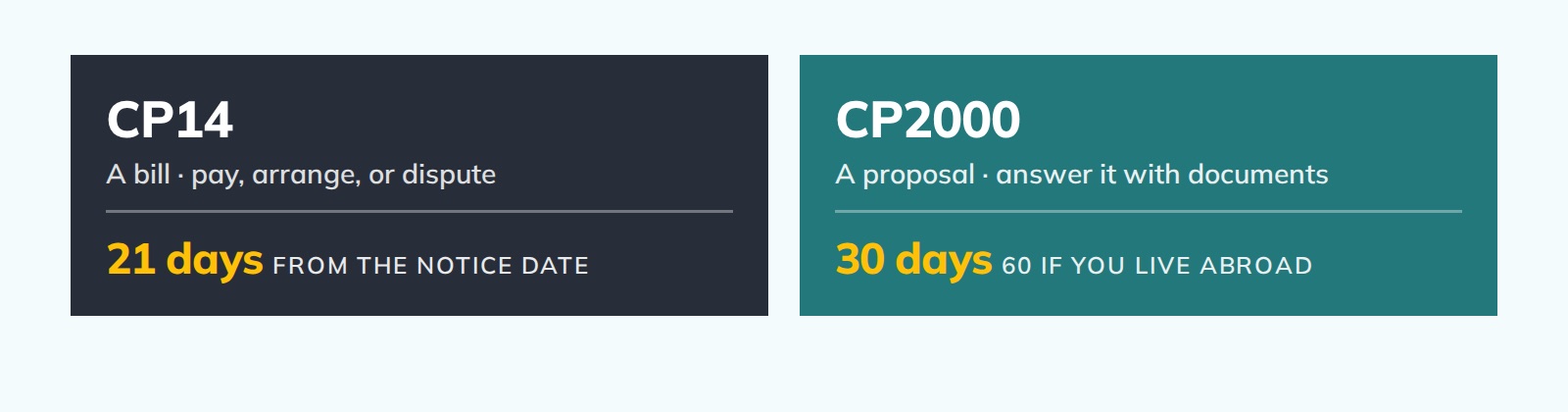
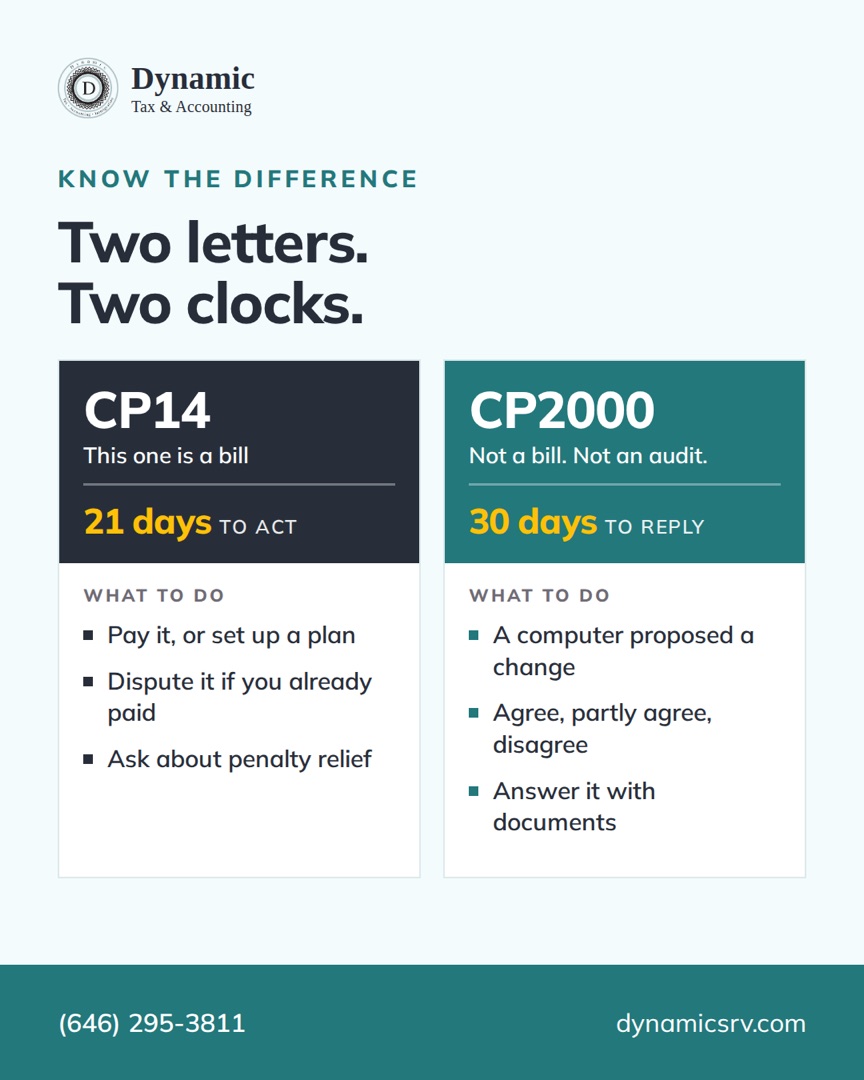
Confusing the two is the expensive mistake. Here’s the whole article in one image:
What’s in this guide
What is a CP2000 notice?
A CP2000 notice is an automated letter proposing a change to your tax return, sent when income reported to the IRS by a third party — an employer, a client, a bank, a payment processor — doesn’t match what appeared on your return. It is not a bill and it is not an audit. It proposes a change and asks you to respond within 30 days.
A CP14 is the other letter entirely: an actual bill, for tax the IRS says you owe and hasn’t received, with a 21-day payment window. Same envelope, same official tone, completely different meaning.
First, confirm the letter is real
Before you respond to anything, do a thirty-second check.
The IRS initiates contact by mail, not by phone call, text, or email. A real notice has a code in the upper-right corner (CP14, CP2000, CP501), references a specific tax year, and directs payment to the United States Treasury — never to an individual, a gift card, a wire transfer, or a crypto wallet. No legitimate IRS notice threatens immediate arrest or demands you stay on the phone.
The strongest verification: log in to your account at IRS.gov and look at your notices and balance directly. If the letter isn’t reflected there, be skeptical.
The CP14: this one is a bill
A CP14 means the IRS believes you owe money and hasn’t received it. It’s the first notice in the collection sequence, and it typically shows up a few weeks after a return is filed or processed.
What usually triggers it for small-business owners
- Filing a return showing a balance due without full payment attached
- Estimated tax payments that came up short — the most common cause we see for Schedule C filers
- A payment applied to the wrong year or wrong tax form
- A math or processing adjustment the IRS made to your return
- Payroll tax deposits that missed a deadline
Your deadline
The CP14 requests payment within 21 days of the notice date. Note that this is the notice date, not the day you opened it — which is precisely why the two days on the counter matter.
What happens if you do nothing
The failure-to-pay penalty runs at 0.5% of the unpaid tax per month (or part of a month), capping at 25%. Interest compounds daily at the federal short-term rate plus 3 percentage points — a rate the IRS resets quarterly, currently 7% for the third quarter of 2026. From there, the notices escalate: CP501, CP503, CP504, and eventually a Notice of Federal Tax Lien or a levy. None of that arrives overnight, but all of it is avoidable.
Your realistic options
- Pay it in full if the amount is right and the cash is available. You can pay online through IRS Direct Pay or your IRS online account — faster than mailing a check, and you get a confirmation number to keep. Fastest, cheapest, done.
- Set up a payment plan. Short-term plans (up to 180 days) and long-term installment agreements can both be requested online. This matters more than people realize: while an installment agreement is in effect, the failure-to-pay penalty drops from 0.5% to 0.25% per month.
- Dispute it. If you already paid, if the payment was applied to the wrong period, or if the underlying adjustment is wrong, call the number in the notice’s IRS Help section with your proof ready — canceled checks, bank records, confirmation numbers.
- Ask for a collection delay if paying would genuinely prevent you from covering basic living expenses. The debt doesn’t disappear, but collection can pause.
- Request penalty relief. First-time abatement exists for filers with a clean compliance history, and reasonable-cause relief exists for legitimate circumstances. Neither is automatic. Both require asking.
The CP2000: this one is not a bill, and it’s not an audit
This is where the real money is won or lost.
A CP2000 comes out of the IRS Automated Underreporter program. A computer compared the third-party forms filed under your Social Security number or EIN — W-2s, 1099-NECs, 1099-Ks, 1099-INTs, brokerage 1099-Bs — against what appeared on your return, found a mismatch, and generated a proposed change.
Read that word again. Proposed. The notice itself says it isn’t a bill. Nobody at the IRS has examined your books, and no human has necessarily reviewed your specific facts. A machine found a gap, and the letter is asking you to explain it.
Your deadline
Respond within 30 days of the notice date — 60 days if you live outside the United States.
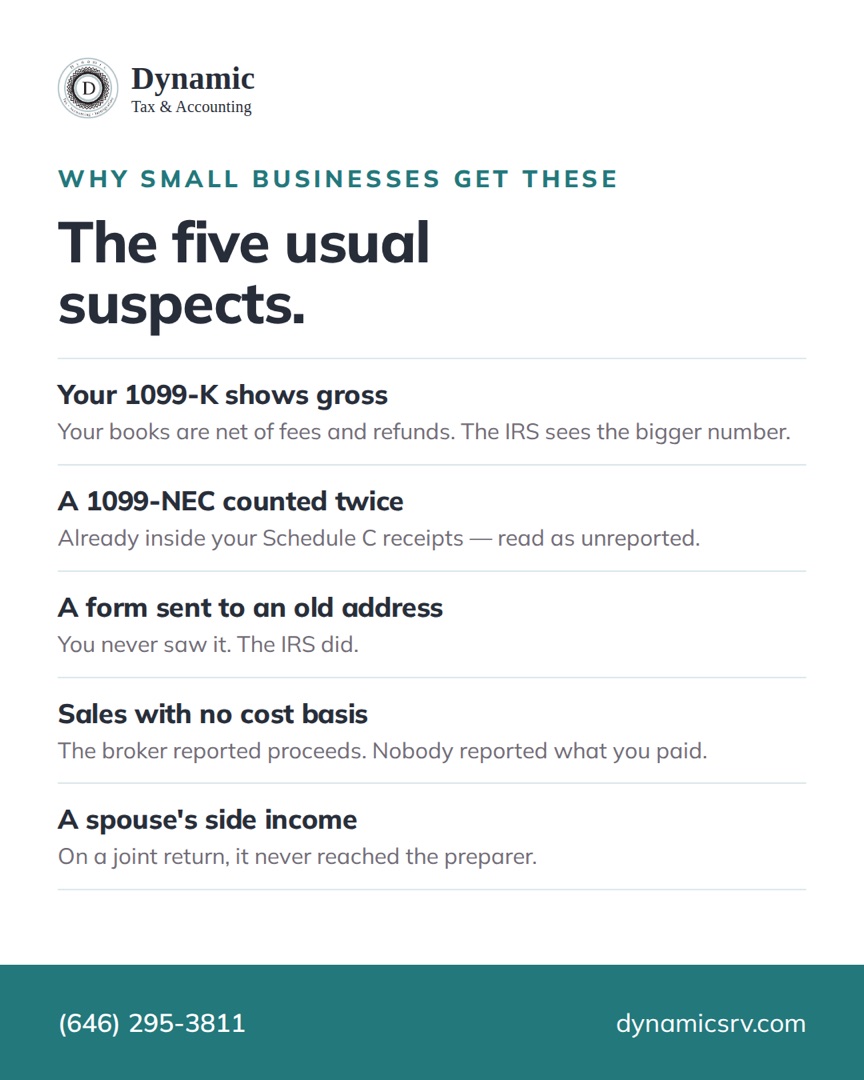
Why small businesses get these more than anyone else
- 1099-K gross versus net. Your payment processor reports total gross transaction volume. Your books, correctly, show revenue net of processing fees, refunds, and chargebacks. The two numbers will never match, and the IRS sees only the bigger one.
- Double-counted 1099-NECs. You reported total gross receipts on Schedule C that already included the 1099-NEC income. The matching system sees the 1099 as separate and unreported.
- A form you never received. A client mailed a 1099 to your old address. You reported the income anyway, but the mismatch is on a different line.
- Stock or crypto sales with no cost basis reported. The broker reports $60,000 of proceeds; the IRS proposes tax on all $60,000 because nobody told them you paid $54,000 for it.
- A spouse’s side income. On a joint return, income that never made it to the preparer.
One more possibility worth ruling out before you assume the income is yours: identity theft. If someone filed a W-2 or 1099 under your Social Security number, that income lands on your record and generates exactly this notice. If you don’t recognize the payer at all, say so in your response and ask about Form 14039.
In every one of those cases, the proposed balance is wrong or substantially overstated — and in several, the correct answer is that you owe nothing. That only happens if you respond.
What happens if you ignore it
The IRS issues a Statutory Notice of Deficiency, sometimes called a 90-day letter. That gives you 90 days to petition the U.S. Tax Court. Miss that window and the proposed assessment becomes final — and then it becomes a real bill, with penalties and interest, and your options narrow dramatically.
The five-step response playbook
- Write down the deadline. Notice date plus 21 days for a CP14, plus 30 for a CP2000. Put it on the calendar with a reminder five days early.
- Pull the actual return for that year. Not last year’s. The specific year on the notice. Compare line by line against what the notice claims.
- Identify the exact item in dispute. A CP2000 lists each discrepancy separately with the payer’s name. Usually one or two lines are the whole story.
- Decide: agree, partially agree, or disagree. All three are legitimate answers, and a CP2000 response form has a checkbox for each. If you agree fully, sign and return it — you generally don’t need to file an amended return. If you disagree, say so in writing and attach the documentation that proves it: your Schedule C, the processor’s fee statement, brokerage cost-basis records, canceled checks.
- Send it so you can prove you sent it. Certified mail with return receipt, or upload through the IRS Documentation Upload Tool if the notice provides an access code. The response address is printed on the notice itself — use that one, not an address from an older letter. Keep a complete copy of everything.
Mistakes that cost real money
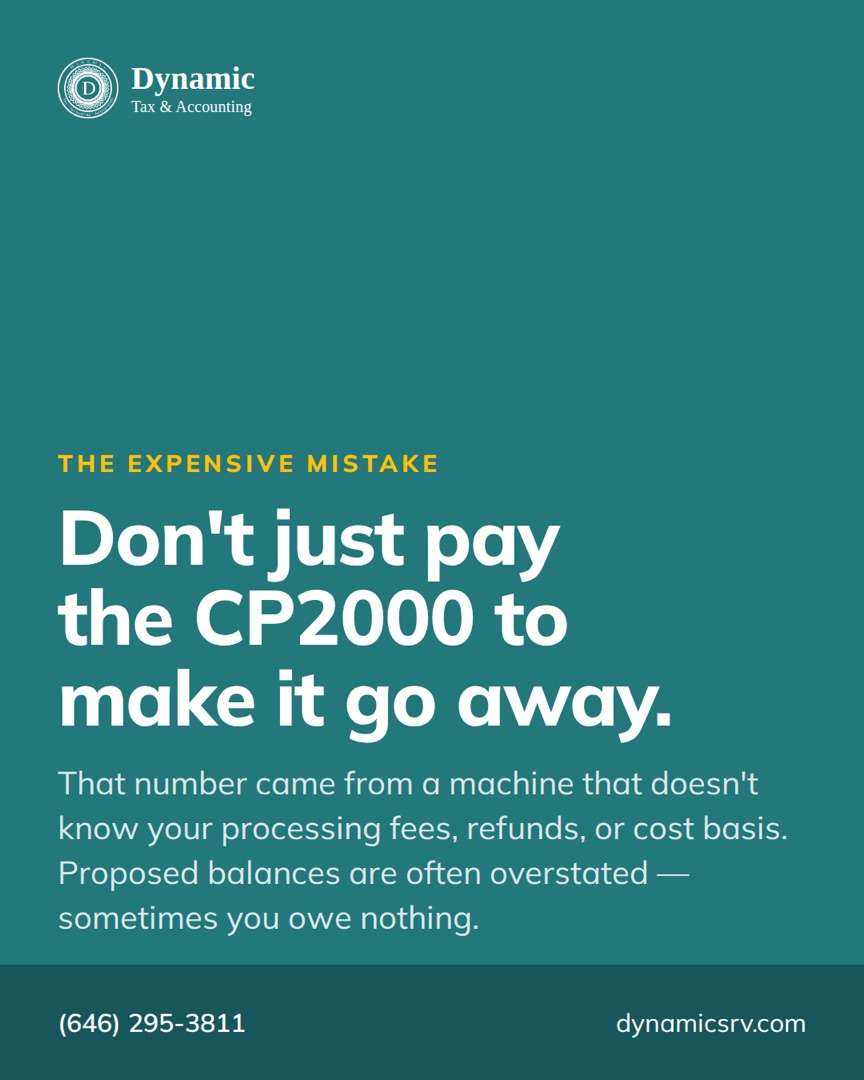
- Paying a CP2000 just to make it go away. This is the most expensive mistake on the list. That number is a machine’s guess based on incomplete information. We routinely see proposed balances in the thousands reduced to zero with a two-page letter and the right attachments.
- Amending a return when a response was all that was needed. For a straightforward CP2000 you agree with, the response form is usually enough. An unnecessary 1040-X adds months of processing and confusion.
- Responding with an explanation but no documents. The IRS is not going to take your word for it. A narrative without records reads as a delay.
- Assuming a CP14 and a CP2000 work the same way. A CP14 is a collection matter — pay it, arrange it, or dispute it. A CP2000 is a factual dispute — answer it. Treating the second like the first means paying tax you may not owe.
- Waiting for the second notice. There’s no version of this where waiting improves your position. Penalties compound, and options quietly close.
Holding One Right Now?
Send us a photo of the notice. We’ll read it, tell you what it actually says, and tell you what the response should be — before the deadline does the deciding for you. Bilingual support available in English and Bangla.
(646) 295-3811 Visit dynamicsrv.comFrequently asked questions
Does a CP2000 mean I’m being audited?
No. It’s an automated matching notice, not an examination. It proposes a change and asks for your response. It does not involve an auditor reviewing your books.
Does responding to a CP2000 trigger an audit?
No. Responding is the expected process — the notice exists to ask you a question, and answering it is what closes the matter. This fear is the single most common reason people leave a CP2000 unanswered, and it costs them money, because silence is what escalates a CP2000 toward a formal assessment. Replying with documentation is the low-risk path, not the high-risk one.
How long after I file does a CP2000 arrive?
Usually a year or more. The IRS has to receive and match all the third-party forms first, so a notice about a return you filed last spring may not land until well into the following year. Getting one long after you filed is normal.
Can I pay a CP2000 online?
Yes, if you agree with the change. IRS Direct Pay and your IRS online account both work, and you’ll get a confirmation number. Pay online only after you’ve satisfied yourself the proposed figure is actually correct.
What if I can’t pay what I owe?
Respond anyway, by the deadline. Payment plans, short-term extensions, and hardship-based collection delays all exist — but you have to engage to access them. An unanswered notice removes options that were available to you.
Can I get penalties removed?
Sometimes. First-time abatement is available to filers with a clean recent compliance record, and reasonable-cause relief exists for circumstances outside your control. Relief is decided case by case and is never guaranteed, but it’s worth asking for — many people simply never do.
What if I already paid and the notice still says I owe?
That happens more than you’d think, usually because a payment was applied to the wrong tax year or form. Gather your proof — canceled check, bank statement, or payment confirmation number — and call the number on the notice. It’s often a straightforward correction.
What if the deadline has already passed?
Respond immediately anyway. A late response is significantly better than none, and if a Notice of Deficiency has been issued you may still have a 90-day window to petition Tax Court. Don’t assume the door has closed — check.
The short version
A CP14 is a bill with a 21-day clock. A CP2000 is a proposal with a 30-day clock, and it’s frequently wrong in the taxpayer’s favor. Neither is an audit. Neither is a criminal matter. Both get harder to fix the longer they sit unopened.
This article is general information, not tax advice for your specific situation. IRS deadlines, penalty rates, and interest rates change; verify current figures at IRS.gov or with a qualified tax professional before acting. No outcome can be guaranteed. Figures current as of August 2026.
Sources: IRS.gov — Understanding your CP14 notice, Understanding your CP2000 series notice, Topic no. 652 (Notice of underreported income), Topic no. 653 (Notices and bills, penalties and interest), and quarterly interest rates. Taxpayer Advocate Service — Notice CP14.
Got a notice on the counter? See our flat monthly pricing plans starting at $99/month, or book a free consultation. Our team at our Bronx, Jamaica/Queens, Buffalo, and Totowa, NJ offices handles IRS notices — plus virtual support in all 50 states. Bilingual English/Bangla. Call (646) 295-3811 to get started today.