A client called in the spring holding a year of bank statements. Forty-one Zelle transfers had come into her account, and none of them showed up on any tax form. Did that mean they were free?
They did not. The gap she was standing in — between what a payment app reports and what you actually owe — is where most payment-app tax trouble begins.
Three things shape the picture. The Form 1099-K threshold has gone back up to $20,000 and 200 transactions, retroactively rather than just going forward. The Form 1099-NEC threshold moved from $600 to $2,000. And Zelle, as always, sends nothing at all.
None of that changed the underlying rule. Income is income whether a form arrives or not. What changed is how much of the tracking now falls to you.
What’s in this guide
Does Zelle report to the IRS?
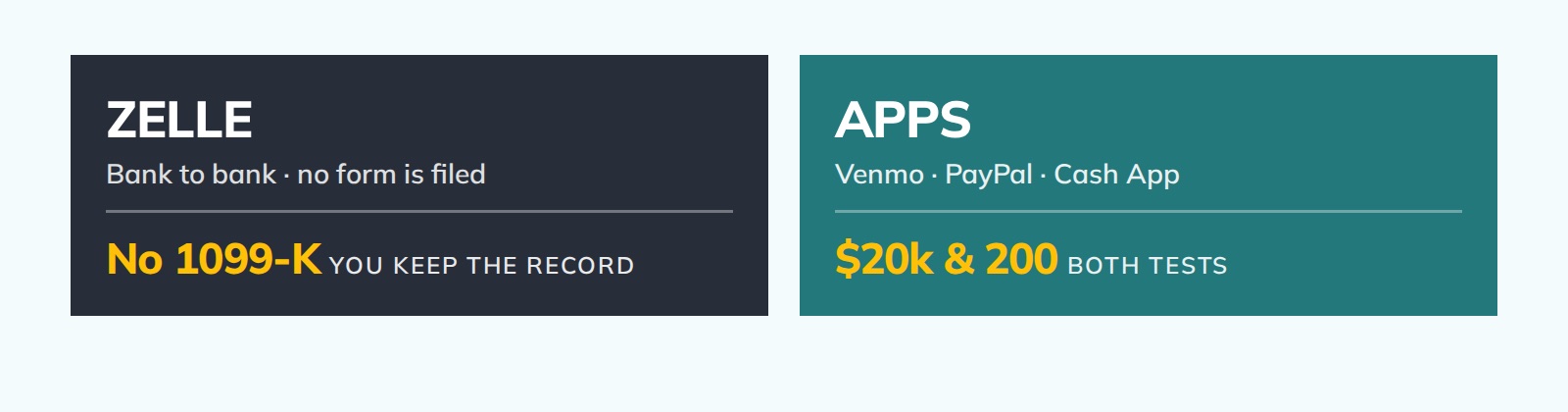
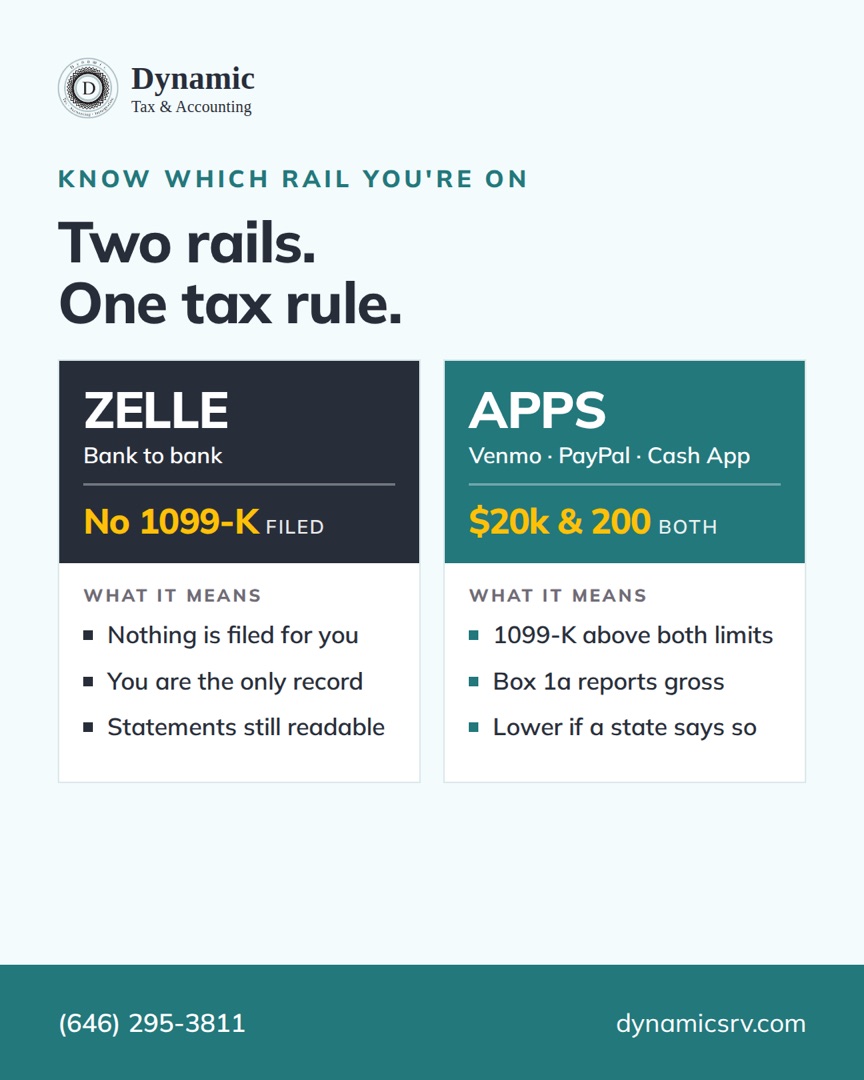
Zelle states that it does not issue Form 1099-K. Its network moves money directly between two bank accounts rather than settling payments on a seller’s behalf — reasoning parallel to the IRS’s own statement that an automated clearing house is not a third-party settlement organization. The IRS has not addressed Zelle by name. Either way, nothing is filed in January, and the income is still fully taxable.
This is not a loophole. The IRS is explicit: all income, no matter the amount, is taxable unless the law says otherwise — even if you never receive a Form 1099-K.
What the absence of a form actually means is that you are the only record-keeper. A contractor paid through Venmo has something to reconcile against. A contractor paid through Zelle has a bank statement and a memory. Bank statements are readable by an examiner. Memory is not a defense.
One form still shows up. Because Zelle is not a third-party settlement organization, a business paying you through it doesn’t get the relief that paying by card or app provides. If a business paid you $2,000 or more across the year in the course of its trade or business, it still owes you a Form 1099-NEC — and may already have filed one with the IRS.
That cuts both ways: pay your own contractor $2,000 or more by Zelle and issuing the 1099-NEC is your job, not the network’s. Payments to corporations are generally exempt.
Do you pay taxes on Zelle payments?
You pay tax on money that is income — payment for work, goods, rent, or services. You do not pay tax on money that is not income: a friend repaying you for dinner, a gift from a relative, a roommate covering half the utility bill, or a transfer between two accounts you own. The app does not sort those categories. You do.
That sorting is easy when the two streams are separate and nearly impossible when they are mixed. An account taking a customer’s $900 invoice on Tuesday and a cousin’s $40 birthday gift on Thursday leaves you defending that distinction later, line by line, from memory.
The fix is boring and it works: business money into a business account, personal money into a personal account, and a note in the memo field on anything ambiguous.
When do PayPal, Venmo, and Cash App send a 1099-K?
A payment app must file Form 1099-K when your goods-and-services payments exceed $20,000 and exceed 200 transactions in the same calendar year. Both tests have to be met, and only goods-and-services payments count — money tagged friends-and-family does not. This is the pre-2022 threshold, restored by the One, Big, Beautiful Bill retroactively to 2022 rather than only going forward.
Three things complicate that clean number.
A form can arrive below the limits. Several states set their own, lower reporting thresholds — New Jersey is one of them — so a 1099-K can land in your mailbox when the federal test is nowhere close to being met. Separately, if a platform ever withheld tax from you because it did not have your Social Security number or EIN, it must file a Form 1099-K for that year regardless of the amount. Check Box 4 for tax withheld; that money is yours and gets claimed on Form 1040, line 25b.
Earlier years followed different rules. Platforms issued Forms 1099-K for 2024 and 2025 under transition thresholds of $5,000 and $2,500. The retroactive repeal does not un-file a form the IRS already holds. If you have one for those years — and if you are finishing a 2025 return on extension, you may — it still has to be addressed on that year’s return.
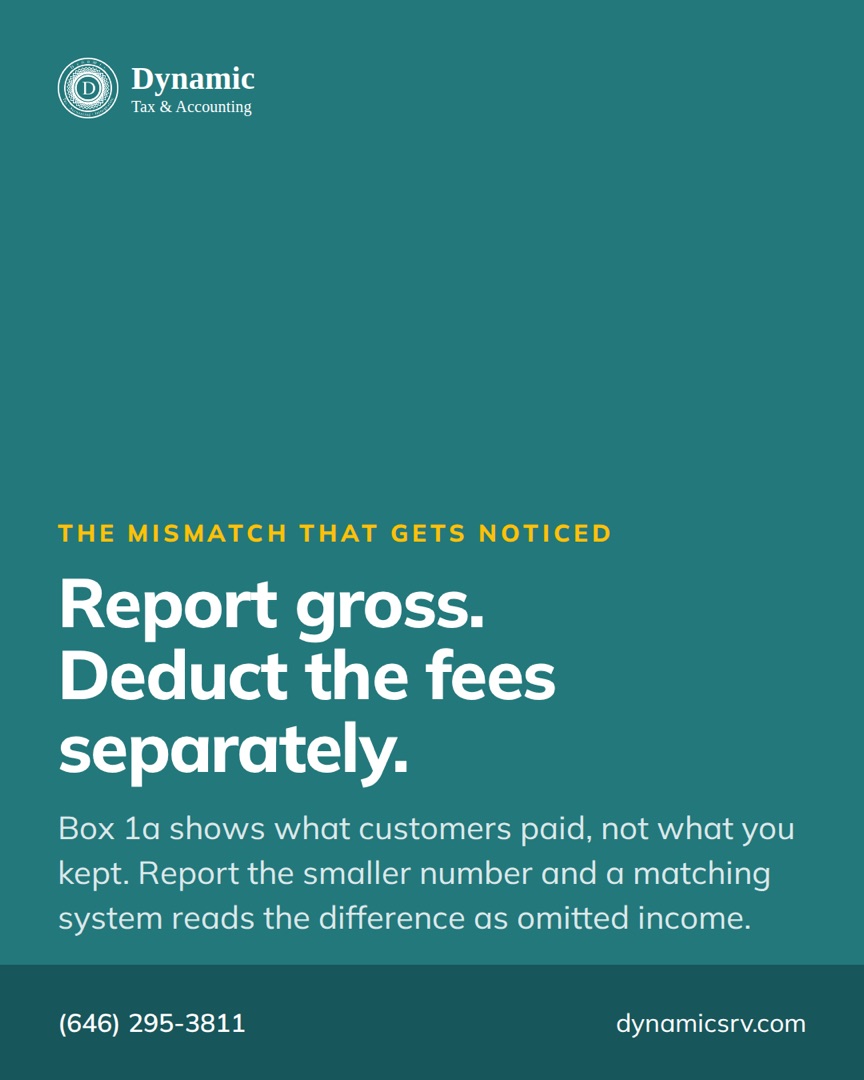
Form 1099-K reports gross, not net. The figure in Box 1a is the total before platform fees, refunds, chargebacks, and shipping costs come out. A seller who collected $46,000 and kept $38,000 after fees and returns will see $46,000 on the form. The IRS sees $46,000 too.
| Where the money came from | Form issued? |
|---|---|
| Zelle | No 1099-K |
| Venmo, PayPal, Cash App — goods and services | 1099-K above $20,000 and 200 transactions |
| Venmo, PayPal, Cash App — friends and family | No 1099-K (and not income, if truly personal) |
| Any app that withheld tax from you | 1099-K regardless of amount |
| Credit and debit card processing | 1099-K with no minimum threshold |
| A business client paying you directly | 1099-NEC at $2,000 or more for the year |
That last row is new. For tax years beginning after 2025, the 1099-NEC and 1099-MISC threshold rose from $600 to $2,000, with inflation adjustments beginning in 2027. More of your smaller client work will now arrive with no form attached. It is no less taxable for it. Drivers and couriers see this constantly — our Uber and Lyft driver tax guide works through the same problem on a Schedule C.
What if the money in your account was not income?
Sometimes a form arrives for something that was never business revenue. The IRS has a documented way to handle it, and it is not “ignore the form.”
A personal item sold at a loss — the old couch, the used bike — goes on Schedule 1, Part I, line 8z as “Form 1099-K Personal Item Sold at a Loss,” with the proceeds amount, and an offsetting amount on Part II, line 24z under the same description, up to but not more than the proceeds. Net effect zero, because personal losses are not deductible.
A personal item sold at a gain is a capital gain. It goes on Form 8949 and Schedule D.
A 1099-K issued in error — personal payments miscoded as goods and services — gets the same two-line treatment: line 8z to report it, line 24z to back it out, both labeled “Form 1099-K received in error.” Ask the platform to correct it as well, but file correctly either way.
The principle behind all three: never leave a form the IRS received unaddressed on your return. Report it, then explain it.
How to report payment-app income on your 2026 return
If the money is business revenue, it belongs in gross receipts on Schedule C, line 1 — all of it, whether or not a form was issued. Platform fees, refunds, and returns come out further down as their own deductions, where they are documented and defensible.
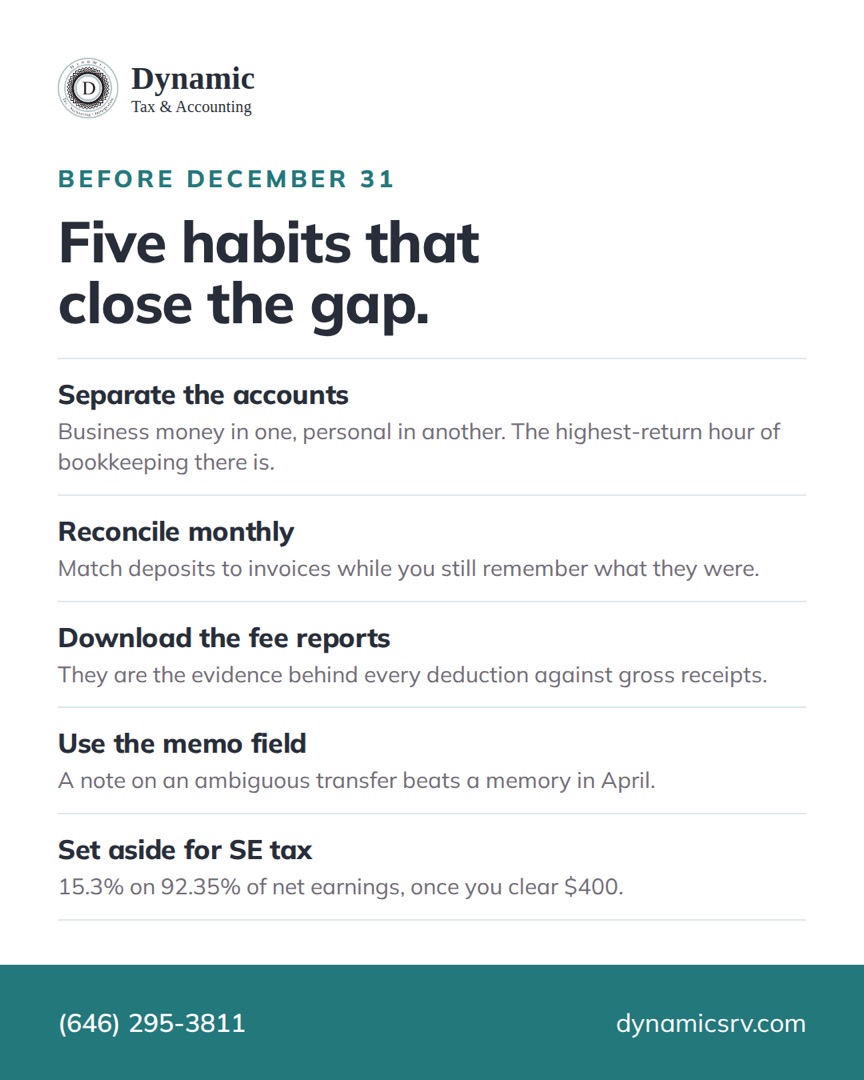
Once net earnings from self-employment reach $400, self-employment tax applies through Schedule SE: 15.3% total, made up of 12.4% for Social Security and 2.9% for Medicare, calculated on 92.35% of net earnings. The Social Security half applies only up to the wage base — $184,500 for 2026 — while the Medicare half applies to everything, plus an additional 0.9% above $200,000 of self-employment income ($250,000 filing jointly). Half of the self-employment tax comes back as a deduction, so the real cost is lower than the headline rate. If that bill looks larger than you expected, it is worth checking whether you are overpaying self-employment tax.
If payment-app income is a meaningful part of your year, quarterly estimated payments usually beat a single April surprise.
Does a 1099-K increase your audit risk?
A Form 1099-K is an information return, not an audit notice. What draws IRS contact is a mismatch — the gross figure on a form the IRS holds is larger than the receipts reported on your return, and an automated matching system flags the difference. A common result is a CP2000 notice. The IRS is explicit that a CP2000 “isn’t a bill” — it is a proposal to adjust your tax, and you can respond to it. We walk through exactly how in our guide to CP14 and CP2000 notices.
A frequent cause is the gross-versus-net trap above: you report the $38,000 you kept, the IRS holds a form saying $46,000, and the system reads an $8,000 omission.
Report the gross figure and deduct the fees separately, and that particular mismatch generally doesn’t arise. It is a formatting decision that closes one of the gaps we most often see behind these letters.
Three other habits reduce the risk meaningfully:
- Separate accounts. One for business, one for personal — the highest-return hour of bookkeeping available to a small business owner.
- Monthly reconciliation. Match deposits to invoices while you still remember what they were. April is too late to reconstruct February.
- Keep the platform reports. The annual fee and refund summaries are the evidence behind every deduction you take against gross receipts.
Free 15-Minute Review
Bring a year of Zelle, Venmo, PayPal or Cash App activity. We’ll walk through what generally belongs on the return, what doesn’t, and how to keep the two apart before the year closes. Bilingual support available in English and Bangla.
(646) 295-3811 Visit dynamicsrv.comFrequently asked questions
Does Zelle tax you?
No. Zelle charges no tax and withholds nothing, and it states that it issues no Form 1099-K. Any income you receive through it is taxable and you report it yourself.
Do you have to report Zelle payments on your taxes?
Yes, if the payment is income. Payment for work, goods, rent, or services is reportable however it arrived. Genuine gifts, reimbursements, and transfers between your own accounts are not.
Is there a dollar limit before Zelle payments become taxable?
No. There is no minimum. The $20,000 and 200-transaction figure is a reporting threshold for payment apps that issue Form 1099-K, not a tax-free allowance, and it never applied to Zelle at all.
When do Venmo, PayPal and Cash App send a Form 1099-K?
When your goods-and-services payments on that platform exceed $20,000 and exceed 200 transactions in the same calendar year. Both tests must be met. Two exceptions put a form in your hands below those limits: a lower state threshold, and any year the platform withheld tax from you because it lacked your taxpayer ID.
Do I need a 1099-K to report income?
No. You report income whether or not a form was issued. The form is a copy of information the IRS already has; its absence changes your paperwork, not your liability.
Will I get a 1099-K for selling personal items?
Only if your goods-and-services payments clear both federal tests, or a state threshold applies. If one arrives for items sold at a loss, use the Schedule 1 line 8z and 24z treatment above.
Does receiving a 1099-K trigger an audit?
A Form 1099-K is an information return, not an audit notice. What draws IRS contact is a mismatch between the gross figure on the form and the receipts reported on your return. A common result is a CP2000 notice, which the IRS describes as a proposal to adjust your tax rather than a bill.
What is the 1099-NEC threshold for 2026?
$2,000. For tax years beginning after 2025 the Form 1099-NEC and 1099-MISC threshold rose from $600 to $2,000, with inflation adjustments beginning in 2027.
I get tips through an app — is there anything new?
Possibly. Tips are still income, but for 2025 through 2028 a deduction of up to $25,000 of qualified tips is available on the new Schedule 1-A, if your occupation appears on the IRS list and your income is under $150,000 ($300,000 filing jointly). It does not reduce self-employment tax. Worth asking whether your work qualifies.
Getting it right before the year closes
The gap between “no form arrived” and “no tax is owed” costs small business owners more than almost any other misunderstanding we see — and it is cheapest to close before the year ends, not after.
If money is coming into your accounts through Zelle, Venmo, PayPal, or Cash App and you are not certain how it should land on your return, we can look at it with you. Dynamic Tax & Accounting works with clients at four offices — Bronx, Jamaica NY, Buffalo, and Totowa NJ — and virtually in all 50 states through our bookkeeping and virtual accounting service. Bangla and English.
Call (646) 295-3811 or visit dynamicsrv.com.
General information, not tax advice for a specific situation. Figures current as of August 2026 — thresholds and rates change, and state reporting rules vary, so verify at IRS.gov and with your state before acting. No outcome guaranteed.
Sources: IRS, “IRS issues FAQs on Form 1099-K threshold under the One, Big, Beautiful Bill” (IR-2025-107 and Fact Sheet 2025-08) · IRS, “Understanding your Form 1099-K” · IRS, “What to do with Form 1099-K” · IRS, “Form 1099-K FAQs: What to do if you receive a Form 1099-K” · IRS, “Form 1099-K FAQs: General information” · IRS, “Form 1099-K FAQs: Should my organization be preparing, filing and furnishing Form 1099-K?” · IRS, “Instructions for Forms 1099-MISC and 1099-NEC (12/2026)” · IRS, “Topic no. 554, Self-employment tax” · IRS, “Topic no. 652, Notice of underreported income — CP2000” · IRS, “Instructions for Form 1099-K” · IRS, “What the ‘No Tax on Tips’ deduction means for you” · SSA, “Contribution and benefit base”
Not sure what belongs on your return? See our flat monthly pricing plans starting at $99/month, or book a free consultation. Individual and small-business returns, bookkeeping, and IRS notice responses from our Bronx, Jamaica/Queens, Buffalo, and Totowa, NJ offices — plus virtual clients in all 50 states. Bilingual English/Bangla. Call (646) 295-3811 to get started today.