Someone told you an S corp would save you 15.3%. They weren’t lying, exactly.
The self-employment tax saving is real, it is legal, and for a profitable one-person business it can run into thousands a year. But almost every version of this advice quotes the gross number and stops there — and the gross number is not what reaches your bank account. Two things claw a large piece of it back, and neither shows up in the online calculators.
What’s in this guide
Does an S corp reduce self-employment tax?
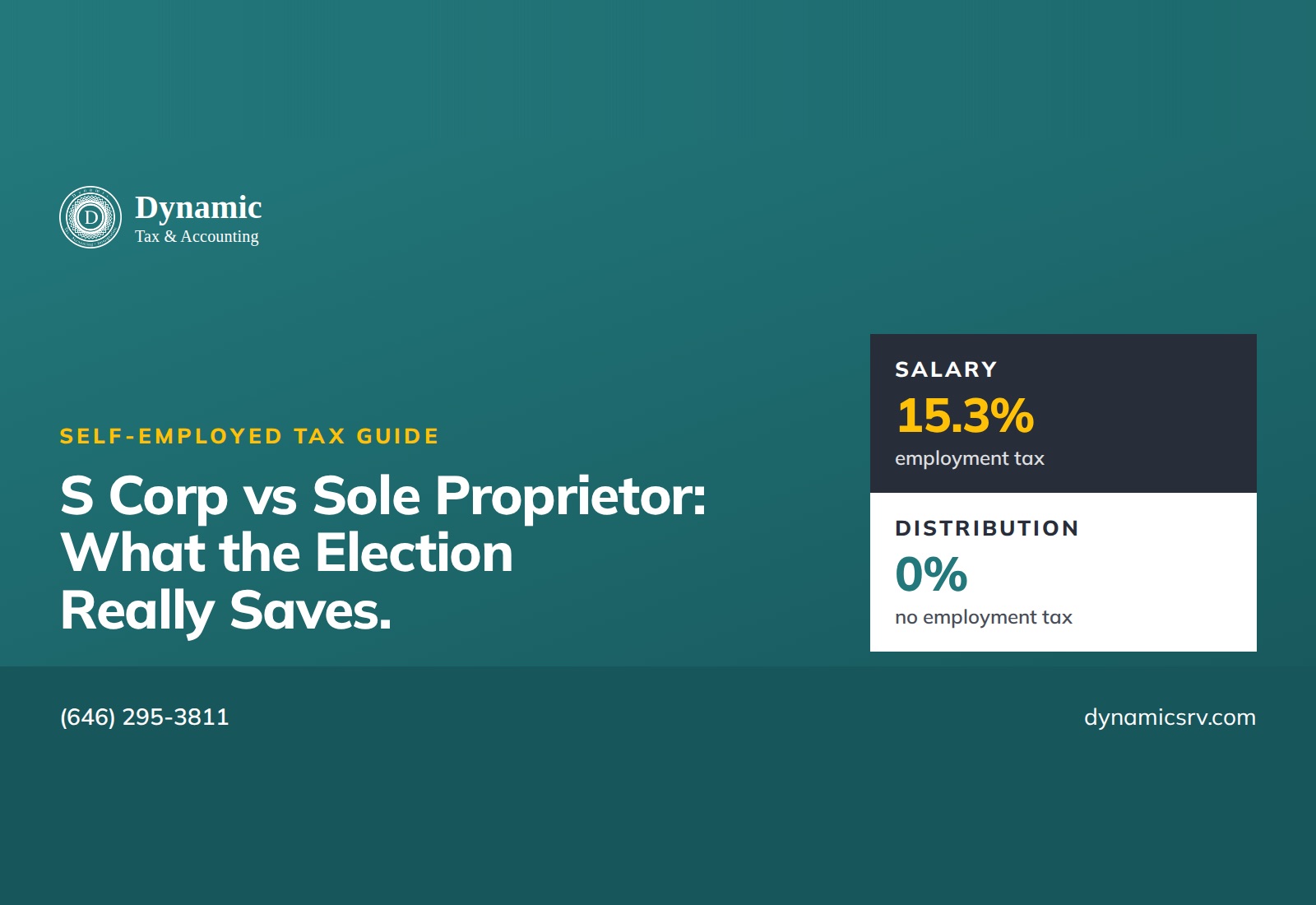
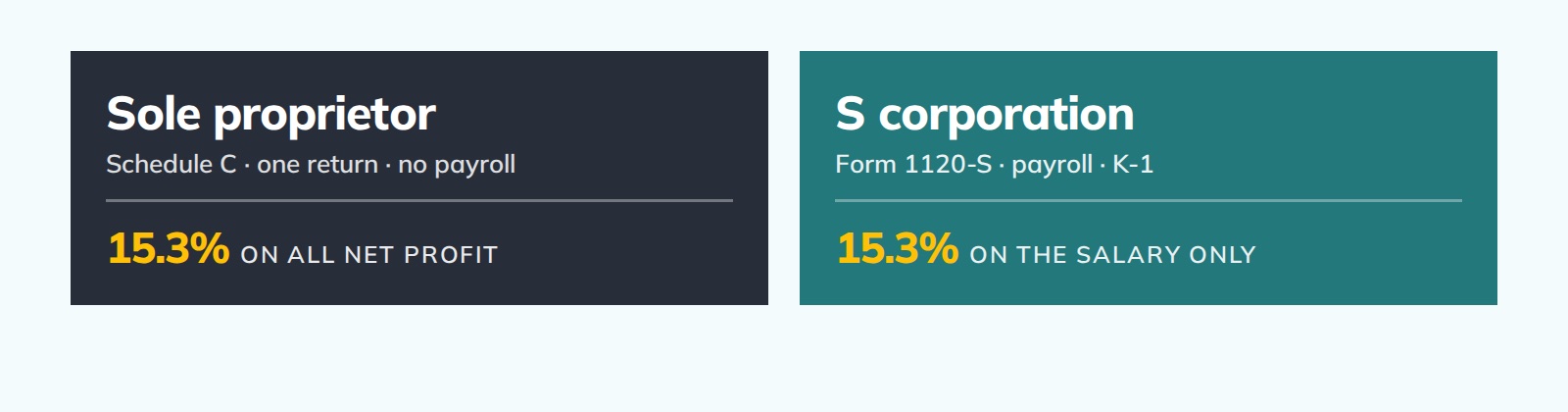
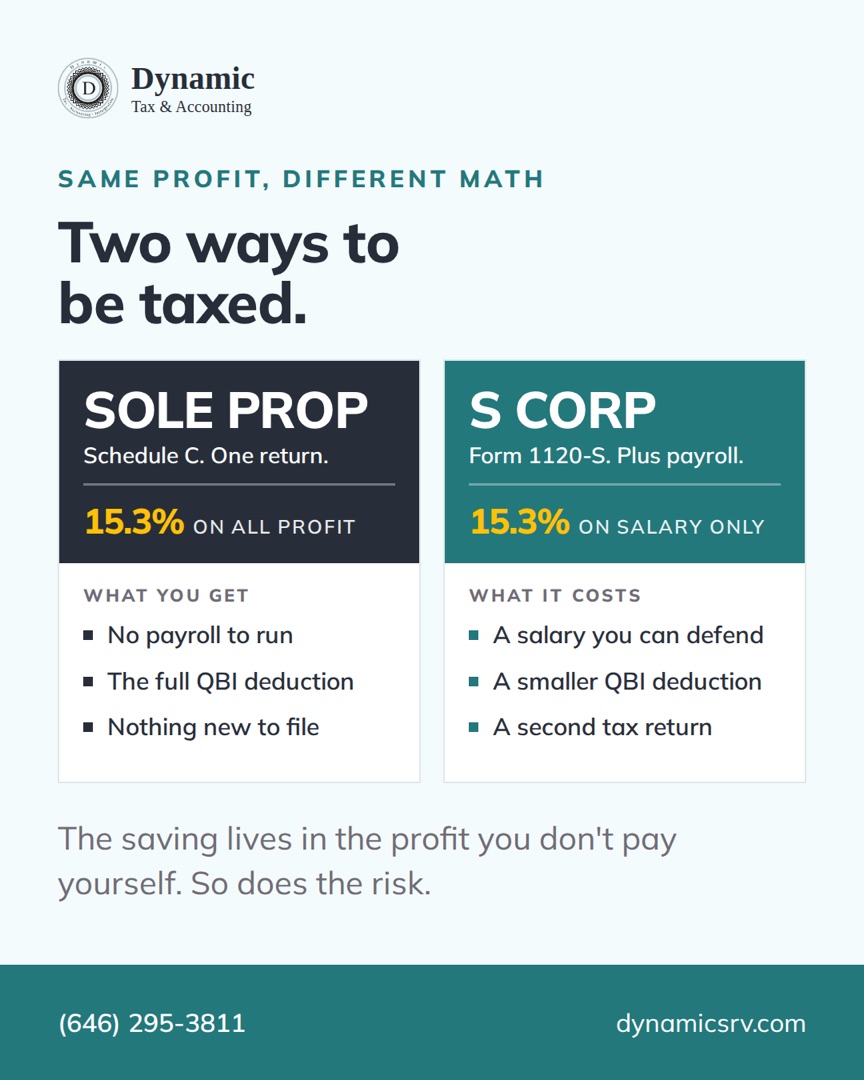
Yes. An S corporation election lets you split your business profit into two parts — a salary, which carries employment tax, and a distribution, which does not. Self-employment tax runs 15.3% on a sole proprietor’s entire net profit. In an S corp, that 15.3% applies only to the salary. The distribution passes through to your personal return as income tax only.
That is the entire mechanism. The rest of this article is about what it costs to run and how much of the saving survives.
How the split works
As a sole proprietor or single-member LLC, you file Schedule C and pay self-employment tax on 92.35% of your net profit. The rate is 15.3% — 12.4% for Social Security, 2.9% for Medicare. For 2026 the Social Security portion applies only up to a wage base of $184,500; Medicare has no cap, and an extra 0.9% applies above $200,000 for a single filer ($250,000 jointly). You deduct half of the self-employment tax when calculating adjusted gross income.
Elect S corporation treatment and the business becomes a separate filer. It runs a payroll, pays you a W-2 salary, withholds employee FICA of 7.65% and pays employer FICA of 7.65% on top — the same 15.3%, but only on the salary. Profit left after salary and expenses is distributed free of employment tax.
The election is not a new company. Your LLC stays an LLC — the same distinction that matters when you’re deciding between 1099 and W-2 work. Form 2553 changes one thing: how the IRS classifies you.
What a $120,000 business actually saves
Take a single-filer sole proprietor with $120,000 of net profit, taking the standard deduction, who elects S corp status and pays themselves a $70,000 salary.
The employment tax layer: self-employment tax on $120,000 is about $16,955. Payroll tax on a $70,000 salary is $10,710, plus federal unemployment tax of roughly $42. Difference: about $6,200 saved.
That is the number you were quoted. Now the two things nobody mentions.
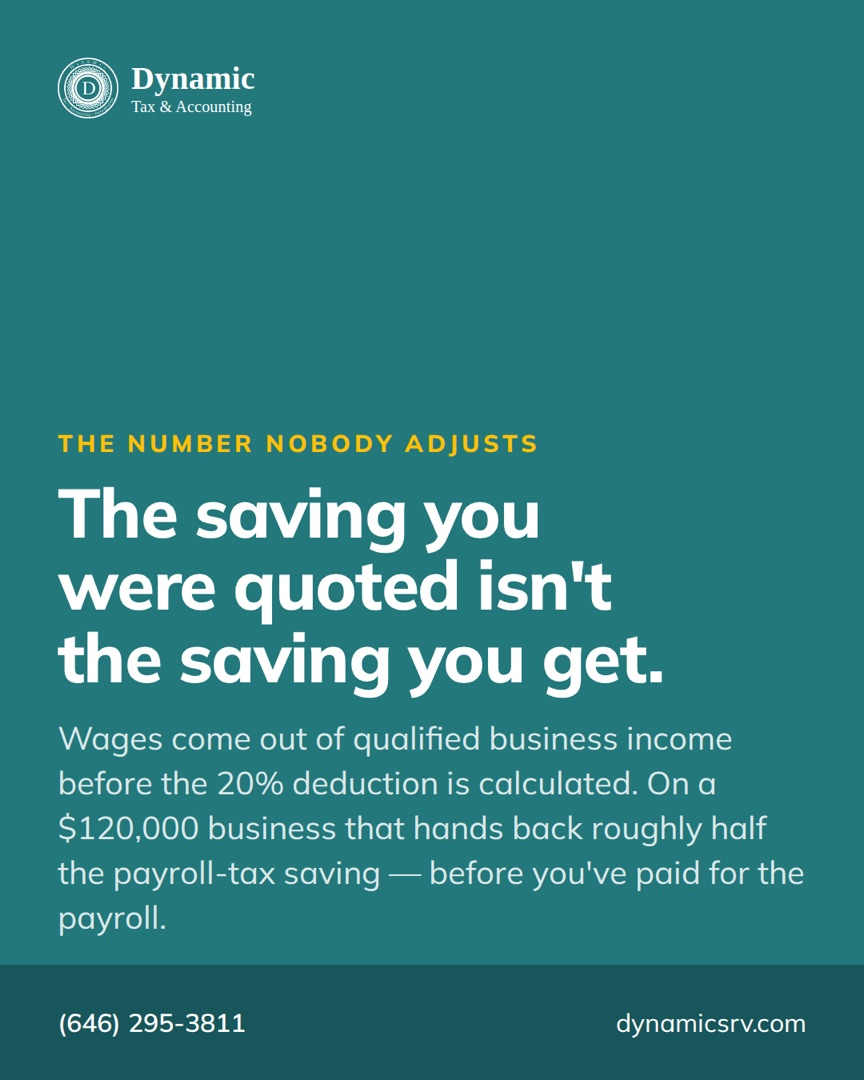
The QBI deduction shrinks. The Section 199A qualified business income deduction — 20% of pass-through profit, made permanent by the One Big Beautiful Bill Act in 2025 — is calculated after the salary comes out. Paying yourself $70,000 in wages removes $70,000 from qualified business income. Here the deduction falls by roughly $10,000, adding back around $2,900 of income tax.
The compliance costs are real. A payroll service, a Form 1120-S return, often an extra state filing: realistically $1,500 to $3,000 a year for a one-person S corp. Worth weighing against the deductions you can already take without changing entity type.
The honest arithmetic on a $120,000 business:
| Employment tax saved | ~$6,200 |
| Income tax added back by the smaller QBI deduction | ~$2,900 |
| Net federal saving | ~$3,300 |
| Typical annual running cost | $1,500 – $3,000 |
| What you actually keep | roughly $300 – $1,800 |
At $200,000 of profit with a $110,000 salary, the same calculation nets closer to $5,800 before running costs — the gap widens as profit grows, because the distribution grows faster than the salary. At $60,000 it nets around $1,600, which is inside the margin of error on the compliance bill.
Figures are illustrative, for a single filer taking the standard deduction with no other income. Filing status, state, health insurance and retirement contributions all move them.
Reasonable salary: why nobody can give you a percentage
The IRS requires an S corporation to pay a shareholder-employee reasonable compensation for services before making non-wage distributions. There is no safe-harbor percentage. The 60/40 and 50/50 splits circulating online are not IRS rules — they are conventions people repeat, and they carry no authority.
What the IRS uses is a facts-and-circumstances test from its own guidance for S corporation officers: your training and experience, your duties, the time you give the business, what comparable businesses pay for the work, and what the business could afford while remaining viable.
The consequence of getting it wrong is specific. The Form 1120-S instructions state that payments to a corporate officer must be treated as wages to the extent they are reasonable compensation for services rendered. The IRS can reclassify distributions as wages, and courts have backed it — in Watson v. United States the Eighth Circuit upheld a finding that a $24,000 salary was unreasonably low for an experienced accountant whose S corp distributed over $200,000 a year. Reclassification brings back payroll tax, plus penalties and interest. Paying yourself nothing while taking distributions draws attention fastest of all.
Setting a number you can defend is the part worth getting help with. That is exactly what our reasonable salary review covers.
What it costs to run
An S corp is a filing entity with its own obligations:
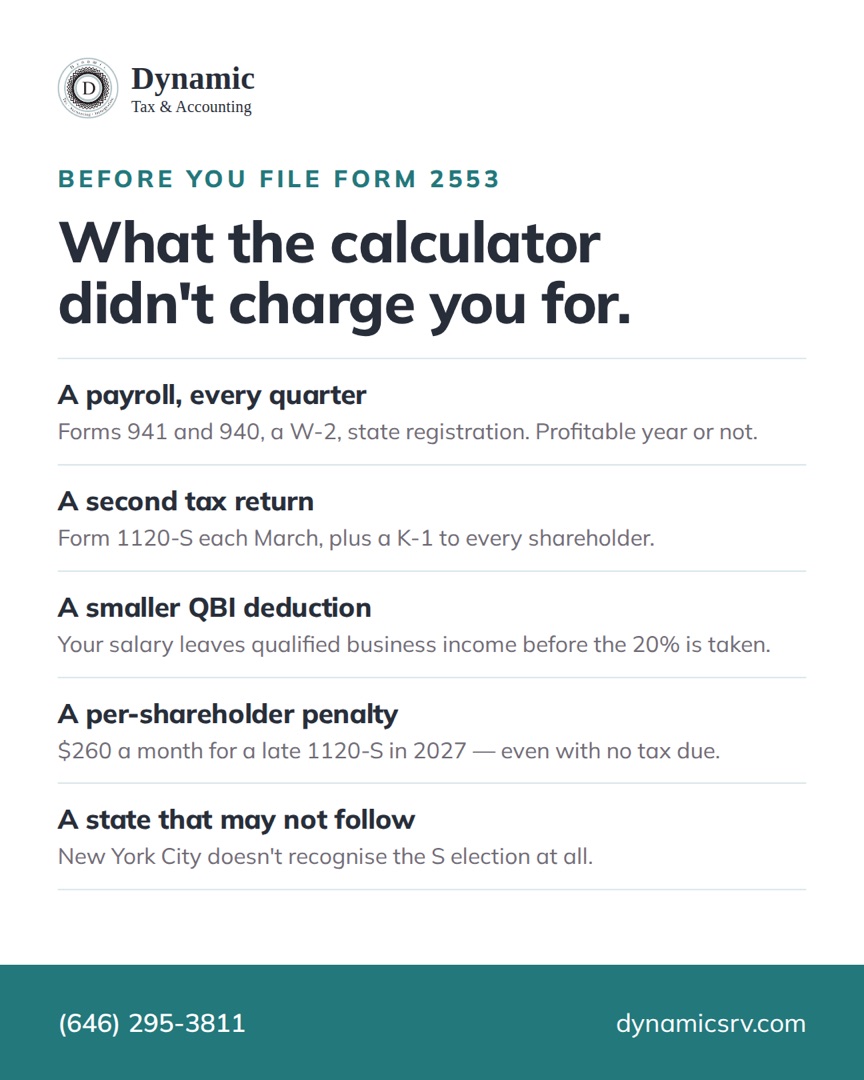
- Form 1120-S every year, plus a Schedule K-1 to each shareholder. Due 15 March for calendar-year filers — 15 March 2027 for the 2026 tax year — extendable six months on Form 7004.
- Payroll. Quarterly Forms 941, annual Form 940, a W-2, state withholding and unemployment registration.
- A late-filing penalty charged per shareholder, per month. For returns due in 2027 it is $260 per shareholder for each month or part-month late, capped at 12 months — and it applies even when the corporation owes no tax.
- A separate state filing in many states, sometimes with a separate state election.
None of this is difficult. All of it is a recurring cost to net off the saving.
Your state does not have to follow the federal election
A federal S election binds the IRS. It does not automatically bind your state. Some states require a separate election of their own, some impose an entity-level tax or franchise fee on S corporations anyway, and at least one major city ignores the election entirely.
New York is the clearest example and it catches people every year. A federal Form 2553 does not make you a New York S corporation — that needs Form CT-6, filed separately with the state, and New York has no equivalent of the federal late-election relief. Worse, New York City does not recognize S corporation status at all. The city’s own guidance is explicit on this point. A federal S corp operating in the five boroughs pays the General Corporation Tax at the entity level, and the shareholders then pay city personal income tax on the same profit.
Other states have their own rules. Check yours before you file the federal form, not after.
When the election makes sense
There is no magic revenue number, and anyone who gives you one is guessing. The election starts to pay when profit is reliably and substantially higher than the salary you would have to pay yourself to be defensible. The saving lives in the distribution, so the distribution has to be large enough to outrun the QBI clawback and the running costs.
Worth modelling when profit is consistently well into six figures rather than one good year, when the business has capital, systems or employees producing profit beyond your own billable hours, and when your state and city do not tax S corporations at the entity level.
Worth waiting when profit is volatile or the business is new, when you are the entire product and a defensible salary would swallow most of the profit, or when you are near the QBI phase-out ($201,750 single, $403,500 joint for 2026), where the wage rules change the calculation again.
How and when to elect
File Form 2553, signed by all shareholders, within two months and fifteen days of the start of the tax year you want it to apply to — for a calendar-year business electing for 2027, that is 15 March 2027. A new entity gets two months and fifteen days from formation. Form 2553 cannot be e-filed; it goes by mail or fax, so keep the confirmation. The IRS generally responds within about 60 days.
Missed it? Late election relief under Revenue Procedure 2013-30 allows a retroactive election within three years and 75 days of the intended effective date, if you had reasonable cause and everyone reported income consistently as though the election were in effect. Write “FILED PURSUANT TO REV. PROC. 2013-30” at the top of the form. Relief fixes timing; it does not fix an entity that was never eligible.
Mistakes that cost real money
- Electing on the gross number. The net saving after the QBI reduction and the running costs is often half the quoted figure or less. Model your own numbers first.
- Taking distributions without running a payroll. The most common S corp error, and the fastest route to reclassification.
- Forgetting the state election. A federal S corp that is still a C corp in its own state is worse than never electing.
- Treating the salary as a number you can lower later. Reasonable compensation is judged on facts, not on what you can afford this quarter.
Free S Corp Check
Send us last year’s net profit and what you’d realistically pay yourself. We’ll show you what the election would actually net after the QBI reduction — and what it would cost to run each year. Bilingual support available in English and Bangla.
(646) 295-3811 Visit dynamicsrv.comFrequently asked questions
How much does an S corp actually save?
Less than the headline figure. On $120,000 of profit with a $70,000 salary the employment tax saving is roughly $6,200, but the smaller qualified business income deduction adds back around $2,900, and payroll and Form 1120-S costs typically run $1,500 to $3,000 a year.
What is a reasonable salary for an S corp owner?
There is no safe-harbor percentage. The IRS applies a facts test covering training and experience, duties, hours worked, what comparable businesses pay for the same work, and what the business could afford while remaining viable. The 60/40 and 50/50 splits circulating online are not IRS rules.
How are S corp distributions taxed?
Not to self-employment or payroll tax. You are taxed on your share of the corporation’s profit as reported on your Schedule K-1, whether or not you take the cash out. Distributions above your stock basis can be taxable as capital gain — which is why basis tracking matters.
Do S corps get a 1099?
Generally no. Payers usually need not issue Form 1099-NEC to a corporation. There are exceptions — attorney fees and medical payments among them — and clients will need a Form W-9 showing your corporate status.
How do I change an LLC to an S corp?
You do not change the LLC. You file Form 2553 to elect S corporation treatment for it. The LLC keeps its state registration, operating agreement and liability protection; only the federal tax classification changes.
When are S corp taxes due?
Form 1120-S is due 15 March for calendar-year filers, extendable six months on Form 7004. The extension covers the return, not the payroll deposits, which run on their own schedule all year.
Does a federal S corp election apply in my state?
Not automatically. Some states require a separate election, such as New York’s Form CT-6, and some tax S corporations at the entity level anyway. New York City does not recognize S corporation status at all.
The short version
An S corp election can cut self-employment tax, and for a genuinely profitable business it is one of the few structural moves that produces real recurring savings. It also adds a payroll, a second return, a reasonable-salary judgment call and, in some states, a tax the federal election was supposed to avoid. The quoted saving and the actual saving are rarely the same figure.
Before you file anything, get your own numbers run — your profit, your defensible salary, your state, your QBI position. We do this across all four of our offices and through our virtual accounting service in all 50 states, and it takes one conversation to know whether the election is worth making.
This article is general information, not tax advice for your specific situation. Tax rates, thresholds and deadlines change; figures are current as of August 2026 and should be verified at IRS.gov or with a qualified tax professional before you act. Entity elections have consequences beyond tax, and no outcome can be guaranteed.
Thinking about the election? See our flat monthly pricing plans starting at $99/month, or book a free consultation. Entity elections, small-business returns and payroll from our Bronx, Jamaica/Queens, Buffalo, and Totowa, NJ offices — plus virtual clients in all 50 states. Bilingual English/Bangla. Call (646) 295-3811 to get started today.